Showing posts with label ENGLISH STENOGRAPHY DICTATIONS. Show all posts

Sunday, 24 November 2024

ENGLISH SHORTHAND DICTATION-413


We have heard the learned Senior Counsel appearing on behalf of the appellants and the learned Additional Advocate General appearing on behalf of the respondents. The learned Senior Counsel appearing on behalf of the appellants submits that the Impugned Act is patently arbitrary, mala fide, discriminatory and violative of Article 14 of the Constitution of India. He submits that the mala fides in passing of the Impugned Act are apparent inasmuch as the statements made by Captain Amarinder Singh, who at the relevant time was in the opposition, would clearly show that he was opposed to the establishment of the100 Khalsa University.

It is submitted that Captain Amarinder Singh had made public statements that he was "touchy" about the Khalsa120 College, that he would not permit the ruling party to tinker with the status of the same and that, after he comes to power, he will reverse the decision. It is submitted that immediately after Captain Amarinder Singh became the Chief Minister of Punjab in 2017, an Ordinance was promulgated repealing the 2016 Act, and shortly thereafter, the said Ordinance got the imprimatur of the legislature by the passing of the Impugned Act dated 17th July 2017.

The learned senior200 counsel further submitted that the State of Punjab had come up with the 2010 Policy and under the said Policy, 16 Universities were established. However, it was only the Khalsa University which was picked up and abolished. He submitted that240 picking up a single University out of 16 Universities which were established as per the 2010 Policy is patently arbitrary, discriminatory and violative of Article 14 of the Constitution. He further submitted that the Impugned Act is passed on a non-existent factual matrix. He submitted that the Statement of Objects and Reasons of the Impugned Act shows that the only300 reason for passing it is to "protect the heritage character of Khalsa College". He submitted that the SOR shows that the Impugned Act was passed on the basis that the Khalsa College has, over a period of time, become a significant icon of Khalsa Heritage and the Khalsa University established in 2016 was likely to shadow and damage its character360 and pristine glory.

He submitted that the Khalsa College was established in 1892 and the appellants had clearly given an undertaking that the establishment of the Khalsa University would not touch the Khalsa College. He submitted that the Khalsa Society400 comprises of various other establishments apart from Khalsa College and that the Khalsa University was established to provide affiliation for only three colleges namely Khalsa College of Pharmacy, Khalsa College of Education and Khalsa College for Women.

He submits that all the three institutions were started after more than half a century of establishment of Khalsa College. It is submitted that Khalsa University had also planned various other colleges or institutions which would be affiliated to it. However, the same480 was to be done without in any way affecting the Khalsa College. As such, it is submitted that the reasoning500 given in the SOR that the Impugned Act was being passed only to protect the heritage character of Khalsa College is formed on a factually erroneous matrix.

The learned senior counsel further submitted that the Impugned Act was patently arbitrary, discriminatory and violative of Article 14 of the Constitution. It is submitted that the Constitution Bench of this Court in the case of Shayara Bano v. Union of India and Others has held that the ground of manifest arbitrariness is also available for examining the validity of a legislation. It is submitted that if it is found that the legislative600 enactment is not based on an intelligible differentia, then such a classification would not be permissible and the enactment would be liable to be struck down on the ground of manifest arbitrariness.

The learned AAG appearing on behalf of the respondents submits that a reasonable classification having a nexus with the object to be achieved is permissible under Article 14 of the Constitution. He submits that merely because Khalsa University has been singled out as against the other Universities established under the 2010 Policy cannot be a ground for holding the Impugned Act to be invalid.

The learned AAG submits700 that there is a presumption with regard to the validity of a legislative action. He submits that the burden with720 regard to invalidity is on the person who challenges it. It is submitted that the classification is based on the fact that the Khalsa College had, over a period of century, received a heritage status. The name "Khalsa" was identified with the Khalsa College. He submitted that the establishment of Khalsa University tinkered with the heritage status of Khalsa College. The learned AAG further submitted that the Khalsa University and the Khalsa College have been established in the same premises800 and therefore there is a possibility of confusion being caused in the minds of a general observer. He further submitted that, over a period of time, the Khalsa College had earned a huge reputation and was playing a leading role840 in Punjabi socio-religious society. It is submitted that the establishment of a private University could diminish its nature.

It is submitted that there was further a possibility that Khalsa Society would allocate greater attention and resources to the private university and neglect Khalsa College which has a historic value. The learned AAG further submitted that the appellants had no vested900 right in their status as a University. It is submitted that shortly after the 2016 Act was enacted, the Impugned Act came to be enacted. During that short period, a few students were admitted. However, the Impugned Act also took care of the said students inasmuch as the colleges where they were studying were affiliated with the other Universities. He960 therefore submits that there is no merit in the appeal and the appeal deserves to be dismissed.

The facts in the present case are not in dispute. The Government of Punjab, Department of Higher Education had come up with the1000 2010 Policy. The 2010 Policy was framed in order to attract high quality private sector investment and expertise in the realm of higher education and provides for establishment and incorporation of private self-financed Universities in the State of Punjab. By the 2010 Policy, it was decided to permit establishment of self-financed universities which shall not receive any grant or aid from the State Government. However, it provided for laying down a rationale proposal and well-defined conditions for the establishment of1080 such universities in order to safeguard the interest of the stakeholders, ex-students, staff members and genuine promoters. 1097


Friday, 8 November 2024

ENGLISH SHORTHAND DICTATION-412


It appears from the record of the Trial Court that after the service of summons on the defendants, they appeared and applied for adjournments for filing the written statement. The first such application was made on 13th December 2001. Subsequent applications were made for adjournments. On 22nd April 2002, the learned trial Judge did not accede to the prayer for grant of further time and passed an order that the suit would proceed ex parte and the date for ex parte hearing was fixed 30th May 2002. At this stage, we may also note that the plaintiffs also made an100 application to strike out the defence of the defendants.

The said application was filed on 18th February 2002. On the120 said application, the Advocate for the plaintiffs made an endorsement in the margin that as there was no advocate representing the defendants, a copy of the application was attached to the said application. Though the date for the ex parte hearing was already fixed as 30th May 2002, on 3rd May 2002, the plaintiffs made an application to the Trial Court for passing an order on the application dated 18th February 2002 for striking out the defendants' defence.

Interestingly, on200 the same day, the plaintiffs moved another application stating that the plaintiffs may be permitted to lead their ex parte evidence through affidavits. It appears that on 3rd May, 2002, the Trial Court allowed the application for striking out the240 defence. Subsequent facts narrated in this judgment would show that the suit was taken on the cause list on that day without any notice to the defendants.

On 16th May, 2002, an application was moved by the defendants for setting aside the order dated 22nd April, 2002. In the application, the averments were made that on 22nd April, 2002, the300 District Judge before whom the suit was pending, was holding a Camp Court at Mussoorie. We may note that the suit was pending in the Court at Dehradun. The contention in the said application was that as the learned District Judge was unavailable, the defendants were under the impression that the suit would not proceed.

In fact, in the affidavit360 filed in support of the said application by one Mukesh Kumar on behalf of the Superintendent of Police, Dehradun, it is stated that he was present on 22nd April 2002 till 4:00 p.m., but the case was not called out.400 On 30th May, 2002, the application for setting aside the order directing the suit to proceed ex parte was rejected. At this stage, we may note here that in the proceedings of 22nd April 2002, it was recorded that on that day, the lawyers had abstained from the Court work, and the learned Presiding Judge was on a tour of Mussoorie for holding a camp.

There is no mention in the proceedings of 22nd April, 2002 that any in charge480 Judicial Officer passed an order to proceed with the suit ex parte. To the specific allegations made by the defendants500 in the application for setting aside the ex parte order that the Judicial Officer was not available, in the reply filed by the plaintiffs in paragraph 4, all that is stated is that the contentions that on 22nd April, 2002, the learned District Judge had proceeded to Mussoorie, are misconceived and the provisions of the Assam and Agra Civil Courts Act are apparent in this respect.

On 1st July, 2002, the defendants applied for setting aside the order dated 3rd May, 2002 by which their defence was struck out. The application proceeds on the allegation that on 3rd May, 2002,600 the Court proceeded to strike out the defendants' defence without giving them an opportunity of being heard and the hearing was conducted ex parte. Very interestingly, a reply was filed to the said application by the plaintiffs in which a stand has been taken that as the suit was directed to proceed ex parte, there was no occasion to give an intimation to the defendants or their counsel that the application will be taken up on 3rd May, 2002.

Therefore, it is an accepted position that the application for striking out the defence of the defendants was taken up on700 the cause list on 3rd May 2002 without issuing notice to the defendants, though on 22nd April, 2002, the next720 date was already fixed as 30th May 2002. The application for setting aside the order dated 3rd May, 2002 was rejected. At this stage, we must clarify the legal position. Even if a defendant does not file a written statement and the suit is ordered to proceed ex parte against him, the limited defence available to the defendant is not foreclosed.

A defendant can always cross-examine the witnesses examined by the plaintiff to prove the falsity of the plaintiff's case.800 A defendant can always urge, based on the plaint and the evidence of the plaintiff, that the suit was barred by a statute such as the law of limitation. Therefore, notwithstanding an order passed earlier to proceed ex parte, while840 deciding an application for striking out the defence, it was the duty of the Court to give an opportunity of being heard to the defendants. However, that was not done.

As the suit was fixed on 30th May, 2002, the defendants were entitled to a notice that the suit would be taken up on an earlier date for hearing the900 application for striking out the defence. When the defendants had appeared in the suit, the act of preponing the date without notice to them or their advocate was completely illegal and contrary to elementary principles of natural justice. Therefore, it follows that the order striking out the defendants' defence is completely illegal, and the said order deserves to be set960 aside.

There is something further which must be noted. As can be seen from the record, the plaintiffs moved an application on 2nd August, 2002 to amend the description of the suit property. The endorsement on the application records that1000 'the case is proceeding ex parte against the defendants'. Therefore, a copy of the said application was not served upon the defendants. As seen from the proceedings, the application was allowed on 2nd August, 2002. Thereafter, the suit was decreed on 24th August, 2002.

It is true that before the application for amendment of the plaint was allowed, the defendants' defence was already struck out. Even if the defendants' defence was struck out, the defendants were entitled to a copy1080 of the amended plaint. What was struck out was the right to defend the suit as unamended. Whether the subsequent1100 plaint will affect the earlier order of striking out the defence will depend upon the nature of the amendment. However, even a copy of the amended plaint was not served on the defendants.

The defendants challenged the ex parte decree by filing a statutory revision application under Section 25 of the Provincial Small Cause Courts Act, 1887, before the learned Single Judge of the High Court. By the impugned judgment, the learned Single Judge rejected the said revision application without1180 noticing the glaring facts borne out from the record.


----------------------------------------------------------------------------------------------------------------------   

THE PITMAN DICTIONARY OF ENGLISH AND SHORTHAND

https://amzn.to/4ec1f8n


PITMAN’S SHORTHAND DICTIONARY

https://amzn.to/3Cl3s3Y


PITMAN POCKET SHORTHAND DICTIONARY

https://amzn.to/48wXyc2


English Shorthand Magazine (Guide to High Sped Writing Based on Pitman English Shorthand) Combined Volume 37

https://amzn.to/3NQUaiQ


Shorthand through Phonetics [Pitman Made Easy]

https://amzn.to/4f7aPeb


Legal English Shorthand Magazine (Set -1) 

 https://amzn.to/4f9IpjC  


High Speed Shorthand-English Dictation Books (7 Volumes)

https://amzn.to/4efF01x


Sunday, 27 October 2024

ENGLISH SHORTHAND DICTATION-411


The case of the prosecution in brief is that the appellant had a land dispute with the deceased. The allegation against the appellant is that on 2nd March 2013, he assaulted the deceased. After that, he caught hold of the deceased by her hair and dragged her up to the village pond. The appellant put her head inside the pond water. The deceased was suffocated to death.

The first informant-Raman, PW-4, informed the police that Himani Devi died due to drowning. Accordingly, an FIR was registered. After the completion of the investigation, a chargesheet was filed against the appellant. The100 prosecution examined ten witnesses. There is no direct evidence. The prosecution relied upon evidence of PW-1, Saloni Devi, the village120 officer.

The prosecution case is that the appellant made an extra-judicial confession before the witness. The prosecution relied upon the evidence of PW-5, Chaprasi, the brother of the deceased. According to PW-5, he saw the appellant holding the hair of the deceased and was taking her towards the pond. Though PW-1 was declared hostile, the Trial Court and High Court relied upon a part of her testimony. The Courts also believed the testimony of PW-5.

The learned counsel appearing for200 the appellant as amicus curiae, has taken us through the postmortem report and testimony of relevant prosecution witnesses. Based on the evidence of PW-9, Dr. Ram Kumar, his submission is that the death was due to drowning, and the prosecution240 has not discharged the burden on it to prove that it was a homicidal death. He submitted that evidence of PW-1, who was declared as hostile, cannot be believed as in the examination-in-chief, the witness did not depose that the appellant made a confession of killing the deceased. However, in the cross-examination made by the public prosecutor, the witness purportedly300 stated that the appellant confessed before her about killing the deceased. He submitted that evidence of PW-1 cannot be believed. As regards the evidence of PW-5, he stated that though the witness deposed that he saw the appellant dragging the deceased towards the pond, PW-2 - Bala, who was allegedly present at that time, did not support the prosecution.

Moreover,360 another witness, Lakhan, was allegedly present there and was not examined by the prosecution. He pointed out that the incident happened in the evening and PW-10, Investigating Officer admitted that there is a temple near the house of the deceased400 and other people lived nearby. He would, therefore, submit that the prosecution has failed to prove the appellant's guilt beyond a reasonable doubt.

The learned counsel appearing for the respondent State, submitted that in her cross-examination made by the public prosecutor, PW-1 has clearly deposed about the confessional statement made by the appellant. He submitted that evidence of a hostile witness need not be rejected in its entirety and that the Court can always rely upon a part of the480 testimony of such a witness.

He submitted that the evidence of PW-5 proves that the appellant was last seen together500 with the deceased, and at that time, he was holding the deceased by her hair. He submitted that this evidence is sufficient to hold that the death of the deceased is homicidal. He submitted that in view of the oral testimony of the said two witnesses, the appellant's guilt has been established.

We have carefully perused the evidence of prosecution witnesses and other documents on record. The prosecution is relying upon the extra-judicial confession made by the appellant before PW-1 and evidence of PW-5 of last seen together. The case of the prosecution is that after an altercation with the600 deceased in her house, the appellant held the deceased by her hair and dragged her to the village pond. The prosecution is relying upon a site map.

It shows that a road separates the pond and the house of the deceased. The sketch shows the existence of a ridge around the pond and two temples on the ridge of the pond abutting the road. The temples are exactly opposite the house of the deceased. According to the prosecution case, the appellant dragged the deceased by holding her hair from her house up to the pond. Between the house of the700 deceased and the pond, there is a road and ridge of the pond.

This means the appellant must have dragged720 the deceased for a considerable distance. The postmortem report records explicitly that no marks of any injury were found on the body of the deceased. In his evidence, PW-9 Dr. Ram Kumar reiterated that there was no injury mark on the body of the deceased. If the prosecution story of the appellant dragging the deceased was true, there would have been some injury on the body of the deceased. Therefore, the absence of any injury marks on the body militates800 against the prosecution's case.

Evidence of PW-9 shows that salt water was found in the trachea and lungs of the deceased. Perhaps to find out whether the water found in the trachea and lungs of the deceased was the water840 in the pond, samples of water from the pond were collected and sent to the laboratory. That is what PW-10, the Investigating Officer, has stated in paragraph 11 of his deposition. He further stated that the Director of the State Judicial Laboratory returned the samples without testing them on the ground that the cause of death was established in the900 postmortem notes.

According to PW-9, the cause of death was due to drowning. However, he was unable to state whether the death was homicidal or accidental. The reason is that it was difficult for him to state whether deceased immersed in water herself or she was forced into water. In fact, in postmortem notes, PW-9 stated that an expert's opinion960 should be sought. Admittedly, an expert's opinion was not sought.

Now, we turn to evidence of PW-1. She was a village Kotwal. She was a signatory to the panchnama of the recovery of the dead body and a signatory to1000 the sketch of the site made by the police. In the examination-in-chief, she stated that on the date of the incident, around 7 p.m., the appellant came to her house and stated that his mother had died. She has not deposed in her examination-in-chief that the appellant stated that he had killed the deceased.

A Statement under Section 161 of the Code of Criminal Procedure, 1973 of the witness was recorded by the police. Obviously, as the said witness made1080 a departure from what she had stated in the police statement, at the instance of the public prosecutor, the witness1100 was declared hostile. The cross-examination of the witness by the public prosecutor shows that the witness was not confronted by showing the relevant part of her statement recorded under Section 161 of Code of Criminal Procedure.

The witness ought to have been confronted with her prior statement in accordance with Section 145 of the Indian Evidence Act. However, in the cross-examination made by the public prosecutor, the witness accepted the suggestion given by the public prosecutor that the appellant came to her house at 7 p.m. on the date of the incident and told her that he had killed his1200 stepmother by putting her head into the village pond.


THE PITMAN DICTIONARY OF ENGLISH AND SHORTHAND

https://amzn.to/4ec1f8n


PITMAN’S SHORTHAND DICTIONARY

https://amzn.to/3Cl3s3Y


PITMAN POCKET SHORTHAND DICTIONARY

https://amzn.to/48wXyc2

Saturday, 28 September 2024

ENGLISH SHORTHAND DICTATION-408


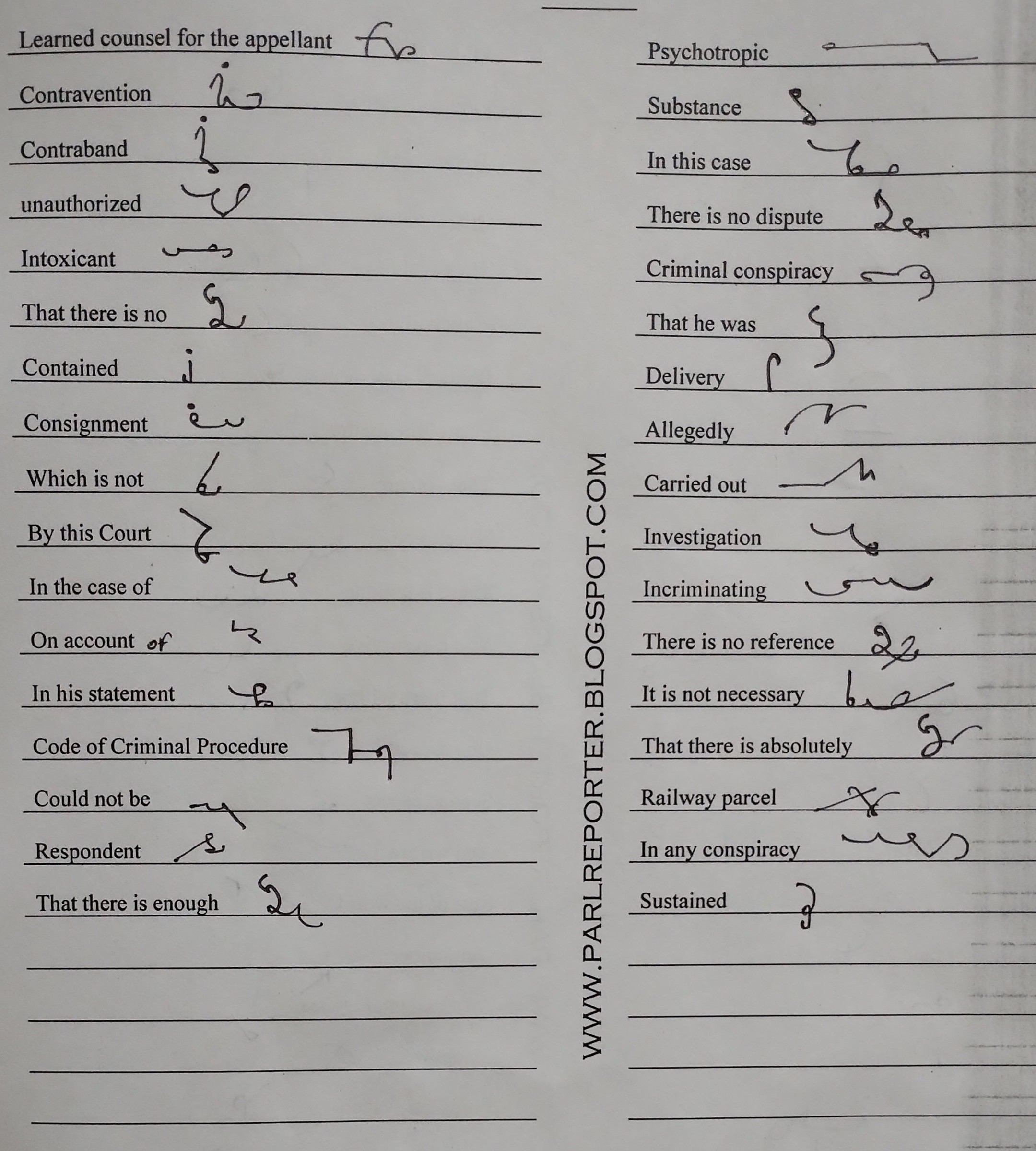
The first submission of the learned counsel for the appellant is that the charge framed against the appellant and accused no.1 was only for the offence punishable under Section 22(c) of the NDPS Act. The allegation, as stated in the charge, was that on 21st December 2013, the appellant and accused no.1 gave cartons of Fortwin injections for interstate transportation without any valid licence and in contravention of Section 8(c) of the NDPS Act. He submitted that no charge was framed against the appellant for the offence punishable under Section 29 of the NDPS Act.

He submitted that the finding100 of the High Court is that the appellant has been prosecuted and convicted for having sold contraband to an unauthorised120 person, leading to the presumption that the contraband was sold to be used as an intoxicant. He submitted that there is no evidence to show that the contraband contained in the consignment booked by the accused no.1 was purchased from the appellant. He submitted that the Courts have placed reliance on the statement of the appellant recorded under Section 67 of the NDPS Act, which is not admissible in evidence as held by this Court in the case of Toofan200 Singh v. State of Tamil Nadu.

He submitted that apart from prejudice caused to the appellant on account of non-framing of proper charge, the allegation of conspiracy under Section 29 of the NDPS Act was not put to the appellant240 in his statement recorded under Section 313 of the Code of Criminal Procedure, 1973. He submitted that unless a charge of conspiracy under Section 29 was proved, the appellant could not be punished under Section 22(c) of the NDPS Act.

The learned senior counsel appearing for the respondent submitted that the accused no.3, who examined himself as a defence witness, 300 placed on record invoices issued to the appellant for sending the Fortwin injections. She submitted that the fact that 30 cartons of Fortwin injections were supplied by accused no.3 at the instance of the appellant has been established through evidence. She submitted that there is enough evidence on record to show that the contraband was supplied to accused no.1 at360 the instance of the present appellant by the accused no.3.

We have perused the notes of evidence and considered the submissions. Under Section 8(c), there is a complete prohibition on possessing and transporting any narcotic drug or psychotropic substance. In400 this case, the contravention involves commercial quantity, for which there is no dispute. Section 22 is attracted when, in contravention of any provisions of the NDPS Act, anyone possesses or transports a psychotropic substance. In the facts of the case, the consignment was booked by accused no.1, and therefore, he was found to be transporting the psychotropic substance in contravention of Section 8(c) of the NDPS Act. There is no allegation against the appellant of transporting the contraband. The consignment480 was booked in the name of the accused no.1 as per the prosecution case. Therefore, unless it is proved that500 the appellant had supplied the consignment to accused no.1 or was a part of a criminal conspiracy to commit an offence under Section 22(c), the appellant cannot be punished.

Perusal of the evidence of accused no.3, who was examined as a defence witness, shows that he was carrying on the business of M/s Renuka Medicals in his wife's name. He stated that he issued invoices for sending Fortwin injections to the appellant. However, there is no evidence on record to show that accused no.3 procured the contraband that is the subject matter of the prosecution and handed it over to600 the appellant or accused no.1.

We may note that the Trial Court and High Court have relied upon the appellant's statement under Section 67 of the NDPS Act. Therefore, the appellant's statement recorded under Section 67 of the NDPS Act is not admissible in evidence and cannot be read in evidence.

The High Court, in paragraph 37 of the impugned judgment, has noted that a statement of the transporter ought to have been recorded to prove that the delivery of consignment containing contraband was made by accused no.3 to the appellant's shop. In fact, the person who allegedly transported the700 contraband from accused no.3 to the appellant was a crucial witness.

However, the prosecution has withheld the evidence of this720 witness from the Court. Hence, an adverse inference must be drawn against the prosecution. In the statement of accused no.1, under Section 67 of the NDPS Act, he stated that he purchased Fortwin injections from the appellant and one Arun Singh several times. However, no investigation has been carried out against Arun Singh.

There is no recovery from the appellant of any incriminating material. There is no evidence to show that the contraband tried to be transported by accused no.1800 by railway parcel was delivered by or on behalf of the appellant to accused no.1. There is no evidence of any conspiracy against the appellant. Therefore, the respondent has not established the offences punishable under Sections 22(c) and 29 of840 the NDPS Act against the appellant beyond a reasonable doubt.

In the charge, there is no reference to the allegation of commission of an offence under Section 29 of the NDPS Act. However, it is not necessary for us to go into the question of whether non-framing of charge under Section 29 of the NDPS Act has resulted in the900 failure of justice. The reason is that there is absolutely no legal evidence on record to show that the contraband attempted to be transported by accused no.1 by a railway parcel was supplied to him by the appellant. There is no evidence of the appellant's participation in any conspiracy. Therefore, the conviction of the appellant cannot be sustained.958


English Shorthand Magazine (Guide to High Sped Writing Based on Pitman English Shorthand) Combined Volume 37

https://amzn.to/3NQUaiQ


Shorthand through Phonetics [Pitman Made Easy]

https://amzn.to/4f7aPeb


Legal English Shorthand Magazine (Set -1) 

 https://amzn.to/4f9IpjC  


High Speed Shorthand-English Dictation Books (7 Volumes)

https://amzn.to/4efF01x 


Sunday, 21 July 2024

ENGLISH SHORTHAND DICTATION-400


Hon. Members, I am delighted to address this first session of both Houses of Parliament after the elections to the 16th Lok Sabha. Let me begin by extending warm greetings to my fellow citizens, who participated in large numbers in the recently concluded Lok Sabha elections. We should never forget that we are here because of them. Serving them should be our first priority. I felicitate the members of the new Lok Sabha. You have successfully obtained the mandate from the electorate and now you represent their hopes and dreams. I extend a warm welcome to all of you and100 hope that the sessions ahead with heavy legislative agenda will be productive and useful. It is a matter of great120 satisfaction that the recent general elections were smooth and largely peaceful. I would like to congratulate the Election Commission of India and the official machinery for conducting these elections successfully. The deep interest shown by the people of India in the elections is a sign of progressive deepening of our vibrant democracy.

Before I dwell upon the tasks ahead of us, I would like to express my solidarity with the families of all those who lost their lives during the200 election process. I congratulate the new Speaker of the Lok Sabha on her unanimous election to this august office. By successively electing women Speakers, the Lok Sabha has re-affirmed our belief in the importance of women in our society. This240 has been an election of hope. It marks a turning point in the evolution of our democratic polity. The surge in aspirations and the belief that these could be realized through democratic processes, has been amply reflected in the record 66 per cent participation by voters, and a clear verdict in favour of a single political party after a300 gap of nearly 30 years. The electorate transcended the boundaries of caste, creed, region and religion to come together and vote decisively in favour of development. The country needed a strong and stable Government that could provide effective leadership.

In my Republic Day speech earlier this year, I had hoped for 2014 to be a year of healing360 after the fractured and contentious politics of the previous years. Standing here today, I applaud the wisdom of my fellow citizens for having voted for stability, honesty and development in a resurgent India in which corruption will have no place.400 They have voted for a united, strong, and modern India. My Government will work to fulfill these aspirations with the involvement of all the 125 crore people of this great country. My Government is committed to nurturing the right environment for actualizing this mandate of the people. We will work together to re-establish the credibility of the institutions of democracy. My government will function on the mantra of ‘Minimum Government, Maximum Governance’. In all our actions, we will480 be guided by the core values of our great civilization.

My Government is dedicated to the poor. Poverty has no500 religion, hunger has no creed, and despair has no geography. The greatest challenge before us is to end the curse of poverty in India. My Government will not be satisfied with mere poverty alleviation and commits itself to the goal of poverty elimination. With a firm belief that the first claim on development belongs to the poor, the Government will focus its attention on those who need the basic necessities of life most urgently. It will take necessary steps to provide security in its entirety to all citizens through empathy, support and empowerment. Containing food inflation will be the topmost600 priority for my Government. There would be an emphasis on improving the supply side of various agricultural products. My Government will take effective steps to prevent hoarding and black marketing. It will reform the Public Distribution System, incorporating best practices from the States. My Government is alert about the possibility of a subnormal monsoon this year and contingency plans are being prepared. Despite more than two-thirds of our people living in rural areas; we have not been able to provide adequate public amenities and livelihood opportunities to them. My Government is committed to improving the quality of life in700 our villages, through empowered Panchayati Raj institutions. A substantial part of investment will focus on creating community assets and improving basic infrastructure such as roads, power and drinking water.

My Government will strive to end the rural-urban divide by providing urban amenities to rural areas while preserving the ethos of the villages. Agriculture is the source of livelihood for majority of our people. In the recent past, our farmers have been under severe stress with hopelessness driving some of them to suicides. My Government is committed to reversing this unfortunate trend. It will increase public and private investment in agriculture800 sector. Steps will be taken to convert farming into a profitable venture through science and technology. My Government will address issues pertaining to pricing and procurement of agricultural produce, crop insurance and post-harvest management. Productivity of Animal Husbandry will be840 increased. Existing cooperative sector laws will be reviewed to remove anomalies and lacunae. My Government is committed to giving high priority to water security. It will complete the irrigation projects on priority. There is a need for seriously considering all options including linking of rivers, for ensuring optimal use of our water resources to prevent the recurrence of floods and900 drought. We will nurture water conservation and ground water recharge.

India is the world’s oldest civilization. Today it is also a country with the largest population of the youth. We must equip and nurture our youth with the right kind of education, skill-set and opportunity to reap this demographic dividend. My Government will formulate a National Education Policy aimed at960 meeting the challenges posed by lack of quality, research and innovation in our educational institutions. We will set up IITs and IIMs in every State. My Government will strive to break the barriers between formal education and skill development, and1000 put in place a mechanism to give academic equivalence to vocational qualifications. The children and youth of the country need avenues of recreation that develop them and keep them fit. My Government will facilitate development and promotion of Indian sports. It will popularize sports by making them an integral part of the school curriculum and providing educational incentives.1058


Saturday, 4 May 2024

ENGLISH SHORTHAND DICTATION-395


Madam Speaker, as we come to the end of the journey of the 15th Lok Sabha, I join all Members of this august House to pay tribute to the manner in which you have conducted the proceedings. Madam, in parliamentary life, there are bound to be differences among parties but there must also be ways and means of finding pathways to bring minimum amount of consistency and reconciliation so that the ship of the Indian State can move forward. We have seen that, on certain crucial matters, this House has the capacity and the will to rise above partisan strife100 and to find pathways of national reconciliation. The manner in which the State of Telangana is being born is yet120 another indication that this country is capable of taking some of the most difficult decisions without any rancour, without worrying too much about the pros and cons of things that do not matter and we can take pride in the fact that the Telangana State, whose quest for being born was pending for the last sixty years, has ultimately seen the light of day. The Food Security Bill is yet another landmark legislation. It will create a ray of hope200 among those who are deprived sections of our community. It will encourage our farmers to produce more. Shri Sharad Pawar has described the manner in which the agricultural situation in our country has improved and I compliment him for the240 manner in which he has guided the destiny of the Agriculture Ministry. Obviously, all Members of the House have played a very important role in bringing that outcome about. Madam, we are now entering a phase where the people of India will once again have an opportunity to assess, to pass their judgement on the performance of Government, weaknesses of300 our Government, the achievements of the Government and it is in that process, that once again a new sense of consensus will emerge which will carry our country to new pathways.

I thank all the hon. Members of the House. I thank the Leader of the Opposition. Once again, I give all Members of this august House my best wishes360 and let us hope that, out of this strife, out of this tense atmosphere which prevailed for some time, there will be a birth of a new atmosphere of hope. With these words, I conclude my remarks by once again400 thanking you, Madam Speaker, for the manner in which you have conducted the proceedings.

Honourable Members, I am pleased to address the joint sitting of Parliament at the start of the third decade of 21st century. I once again extend my best wishes for the New Year and congratulate all Members of Parliament for being a witness to this historic occasion. This decade is very important for India. In this decade, we will complete 75 years of our480 independence. In this decade, we all have to work together with new energy to give impetus to the making of500 a new India. With the efforts of my Government, a strong foundation has been laid in the last five years, to make this decade India’s decade and this century India’s century.

The Constitution of India is the guiding light for all of us in fulfilling these dreams. Just a few weeks ago, on 26th November, 70 years of the Constitution have been completed. On that day, 12 crore citizens of the country, publicly read out the Preamble of the Constitution and renewed their commitment to the Constitution. In addition to protecting the rights of every citizen of our country,600 our Constitution makes the citizens of the country mindful of their duties. Further, our Constitution also places an expectation that the decisions taken through democratic process will be accepted by the countrymen. At the same time, our Constitution expects the Parliament and every member present in this House to fulfil the hopes and aspirations of the countrymen and make the necessary laws, keeping the national interest paramount. I am happy that in the last 7 months, Parliament has set new standards in conducting its business. The performance during the first session of this Lok Sabha has set a new record700 in the last seven decades. Due to my Government’s strong commitment, several historic legislations have been enacted. The faith reposed720 by the people of this country in our democratic institutions strengthens the foundation of our democracy. My Government is of the firm view that mutual discussions and debates strengthen democracy. At the same time, any kind of violence in the name of protests weakens the society and the nation.

In a democracy, nothing is more sacred than the mandate given by the people. The people of the country have given this mandate to my Government for the making of a800 new India. For making such a new India and for fulfilling the expectations of the people, my Government is working with commendable pace and decisiveness to bring about changes in every field. It is the outcome of reforms at the840 grassroot level ushered in by the Government in the last five years that there has been an unprecedented improvement in India’s global ranking in several areas. The success of the public welfare schemes of my Government and the historic decisions taken by the Government have increased the expectations of the countrymen, as well as the responsibilities of the Government. Over900 40 lakh people living in the capital city of Delhi, had been living for many years in the hope that one day they would get the ownership rights of their homes and that they will be able to lead a dignified life. The Government has fulfilled this long-awaited expectation of people living in more than 1,700 colonies of Delhi.960 Farmers, agricultural labourers, unorganized sector labourers and small traders of the country had expectations of a pension scheme that would be of help to them in their old age. My Government has not only fulfilled their wish, but has also1000 covered about 60 lakh beneficiaries so far, under these pension schemes.1011 


Wednesday, 17 April 2024

ENGLISH SHORTHAND DICTATION-390


Hon. Members of Parliament, as I stand here today to greet you, my mind is filled with emotion, and the recent past of India, with its travail and struggle, passes before my eyes. We meet in this sovereign Parliament of the Republic of India, and the high enterprise of serving our motherland and the millions of our people has been entrusted to us. That is an immense and sacred trust and, as your President, I approach it with humility and prayer. On this historic occasion, our thoughts naturally turn to Mahatma Gandhi and our hearts pay homage to him. Let100 us accept our great task in the spirit of the Father of the Nation, who brought us our freedom, and120 let us always remember the message that he gave us, the message of unity and goodwill between all the people of India, of communal harmony, of the abolition of class distinctions and of those based on birth, caste or religion, and the evolution of a peaceful, cooperative India, which gives opportunities of progress to all her citizens. It is the firm policy of my Government to maintain peace and friendship with all the nations of the world and to help200 in every way possible in the maintenance of world peace. The Republic of India inherits no enmities or traditional rivalries with other nations and my Government intends to continue a policy directed towards securing peace in the world and avoiding240 any alignment which leads to hostilities with any nation. India is a sovereign democratic Republic, but she has decided to continue her association with the Commonwealth of Nations. That is a unique development, new to constitutional law and history. We thereby do not limit our freedom in any way, but we indicate our desire for continued friendship and co-operation with300 the group of nations represented in the Commonwealth. My Prime Minister recently attended the Conference of Commonwealth Foreign Ministers held in Colombo. That conference was an example of how independent nations can meet together and discuss, in a friendly way, the great problems that face the world and endeavour to find common ways of action, without in any way infringing360 upon the independence and sovereignty of one another. Our relations with foreign powers are friendly and my Government has exchanged diplomatic representation with a very large number of countries. Treaties of friendship have been concluded with Switzerland, a country with400 a great tradition of democratic freedom, and with Afghanistan with whom we have been bound by cultural and historical ties since the dawn of history. Negotiations have been proceeding for treaties of friendship and commerce with Iran, Nepal and the United States of America. As you are aware, India’s Prime Minister visited this great country recently and his visit led to a greater understanding and respect and closer ties between India and the United States. My Government has recently accorded480 de Jure recognition to the new Government of China and it is hoped that an exchange of diplomatic representatives will500 take place soon. With this great country we have had friendship and cultural contacts for more than two thousand years. I trust that those friendly contacts will be maintained and will help in preserving the peace of Asia and the world. With the nations of Europe, America and Australasia, India is developing friendly contacts. It is natural that India should be even more interested in Asia, of which she is a part, as well as in Africa. Her primary interest is in the freedom of peoples and in the removal of all barriers that come in the way of the600 full development of nations and peoples. She is entirely opposed to the continuation of colonial rule, in any shape or form, as well as to any kind of racial discrimination. In Asia freedom is on the march; at the same time there is trouble and turmoil in some parts of it. I earnestly trust that out of this turmoil will emerge peace and freedom and co-operative relations between all the countries of Asia. A historic event took place recently in the establishment of the free and independent United States of Indonesia. We have welcomed this more particularly because of the700 very close relations, both in the past and in the present, between the people of India and the people of720 Indonesia. It has been an honour and privilege for us to welcome the President of the United States of Indonesia and to convey to him and to his people our greetings and good wishes. India has large numbers of her children living in countries abroad, notably in Africa, in Fiji, in the West Indies, in the island of Mauritius and elsewhere. Our advice to them has always been that they should identify themselves with the indigenous people and look upon800 the country of adoption as their real home.

I regret to say that our relations with our neighbour country, Pakistan, are not as good as they should be and there are several matters in dispute between us. Our history and840 culture as well as the immutable facts of geography, compel both India and Pakistan to live in friendly co-operation with each other. But the grievous wound caused by recent events will take some time to heal. It is my Government’s policy to endeavour to help in every way this process of healing. In pursuance of this policy, my Government has900 proposed to the Government of Pakistan that both the Governments should make a solemn declaration for the avoidance of war as a method for the settlement of any disputes between them, and to resort to negotiation, mediation, arbitration or reference to some international tribunal, in order to settle such disputes. I trust that the Pakistan Government will accept this offer960 in the spirit in which it has been made and thus help to reduce the unfortunate tension that has existed between the two countries.984


OUR YOUTUBE PLAYLISTS:

English Shorthand Dictations 100 WPM
https://www.youtube.com/playlist?list=PLFlI-vIVyBTel1r2jyeY0USWxqmx_Hb6L


English Shorthand Dictations 120 WPM
https://www.youtube.com/playlist?list=PLFlI-vIVyBTeYhTnQpOywVypuFddKPt8k

English Shorthand Legal Dictations 
https://www.youtube.com/playlist?list=PLFlI-vIVyBTdwRYDwKvyhM00ky9TRnoJI  


Tuesday, 16 April 2024

ENGLISH SHORTHAND DICTATION-389


We have heard the learned counsel for the appellant and the learned counsel for the respondent for the insurer. The controversy in the present case pertains to the factum of repudiation of the insurance claim of the complainant on the ground of the material suppression of information regarding the previous policies allegedly held by the insured-deceased, while taking the life insurance policy from the opposite party.

The learned counsel for the appellant submitted that the insurance company has not proved that appellant's father had any other insurance policy while taking the insurance policy from the opposite party. Thus, there100 has been no material suppression of fact in the application form with respect to holding any previous policy by the120 insured-deceased or his family members. It was further submitted by the appellant that the NCDRC was incorrect in upholding the repudiation of claim in the absence of an iota of documentary evidence on record to support the contention that the insured-deceased had suppressed any fact under Clause 6 of the proposal form about the previous policies issued by other insurers. The respondent has merely alleged the fact of multiple insurance policies of the insured-deceased through their affidavit of evidence200 but had not discharged their burden of proof by leading any documentary evidence to support their allegation.

The learned counsel for the respondent has supported the judgment of the NCDRC and has further contended that the insured-deceased had taken240 fifteen other insurance policies worth Rs.71,000/- prior to the issuance of the subject policies by them. These policies were not disclosed in the proposal forms and had the respondent been aware about these other insurance policies with other insurance companies and the existing risk cover at the time of assessment of risk under the subject policies, they would have certainly300 not issued the subject policies to the insured-deceased. Thus, the insured-deceased has suppressed the material fact and the claim has been rightly repudiated on this ground alone.

The learned counsel for the respondent further submitted that the policy of life insurance is based upon the principle of utmost good faith. When a specific fact is asked for in the360 proposal form, an assured is under a solemn obligation to make a true and full disclosure of the information on the subject which is within the best of his knowledge. In the present case as well, the insured-deceased was under400 the obligation to make complete and honest disclosure of all the facts and materials at the time of filling of the proposal form. The failure to do so shows the mala fide intention on the part of the insured-deceased and renders the policy invalid and inoperative.

Having heard the learned counsel for the respective parties, the point that arises for consideration before this Court in the present Civil Appeal, is, whether the respondent herein was correct in repudiating the480 claim of the appellant on the ground of suppression of material information pertaining to the existing policies with other insurers.500 In order to answer the aforesaid question, it would be useful to recapitulate the relevant provisions of the law of insurance and evidence, vis-à-vis burden of proof and the method of discharging that burden of proof to prove an alleged fact, which is suppression of a material fact while seeking an insurance policy from an insurer.

The repudiation of an insurance claim is largely governed by Section 45 of the Insurance Act, 1938. Section 45 is a special provision of law, which bars the calling in question of an insurance policy beyond expiry of the stipulated600 period, except in a few circumstances that have to be proved by the insurer.

Since the present case deals with a policy and its repudiation before the 2014 amendment to Section 45 of the Insurance Act, the pre-amendment time period of two years would be applicable to the case. As per the aforesaid language and interpretation of Section 45, the insurer cannot question the policy after the expiry of the time period and if it does, then the burden rests on the insurer to establish materiality of the fact suppressed and the knowledge of the insured700 about such suppression, so that the repudiation of the claim could be justified by the insurer. In the present case,720 the onus was on the insurer to show that the insured had fraudulently given false information and the said information was related to a material fact. The second aspect of the controversy would be dealt with first.

For a better appreciation of the controversy, it would be important to analyse the principle of utmost good faith that governs the insurance contracts. It may also be observed that insurance contracts are special contracts based on the general principles of full disclosure800 inasmuch as a person seeking insurance is bound to disclose all material facts relating to the risk involved. Law demands a higher standard of good faith in matters of insurance contracts. The plea of utmost good faith has also been840 taken by the respondent, for contending that the insured-deceased had a duty to disclose the details of the previous policies, as the same was sought in the application form. However, the insured failed in his duty to correctly answer the question about his previous policies.

Just as the insured has a duty to disclose all material facts, the insurer900 must also inform the insured about the terms and conditions of the policy that is going to be issued to him and must strictly conform to the statements in the proposal form or prospectus, or those made through his agents. Thus, the principle of utmost good faith imposes meaningful reciprocal duties owed by the insured to the insurer and vice versa. This inherent duty of disclosure was a common law duty of good faith originally founded in equity but has later been statutorily recognised as noted above. It is also open to the parties entering into a contract to extend1000 the duty or restrict it by the terms of the contract.

The duty of the insured to observe utmost good faith is enforced by requiring him to respond to a proposal form which is so framed to seek all relevant information to be incorporated in the policy and to make it the basis of a contract. The contractual duty so imposed is that any suppression or falsity in the statements in the proposal form would result in a breach of1080 duty of good faith and would render the policy invalid and consequently repudiate it at the instance of the insurer.1100 The basic test hinges on whether the mind of a prudent insurer would be affected, either in deciding whether to take the risk at all or in fixing the premium, by knowledge of a particular fact if it had been disclosed. Therefore, the fact must be one affecting the risk. If it has no bearing on the risk, it need not be disclosed and if it would do no more than causing insurers to make inquiries and delaying issue of the insurance, it is not material if the result of the inquiries would have no effect on a prudent insurer. 1200