Showing posts with label English Shorthand Dictations. Show all posts

Friday, 27 December 2024

ENGLISH SHORTHAND DICTATION-417


The Protection of Women from Domestic Violence Act, 2005 is one of the first in this sphere. This Act has concretely dealt with the problem of domestic violence taking into consideration all the related laws and has attempted to reduce the numerous ancillary problems generally faced by such legislations. This legislation is well placed in the Indian context and social scenario, clearly reflective of the mindset of the Indian men. This commentary primarily looks into the provisions of this Act from the constitutional perspective – the Fundamental Rights to be particular. The main aim of the commentary is to bring to100 light the numerous rights, most of which are constitutionally guaranteed, of women who are protected directly or indirectly by this120 Act. The all-encompassing nature of the legislation is elucidated among the other positive aspects of this law. The Act is thus a very vital piece of legislation from the feminist perspective of law. However, one of the main and primary criticisms of the writers is that this Act intentionally or unintentionally neglects to address the issue of child abuse among male children. This persisting problem having been left without any such specific laws requires quick and immediate addressal.

Domestic violence200 is sadly a reality in Indian society. In the Indian patriarchal setup, it became an acceptable practice to abuse women. There may be many reasons for the occurrence of domestic violence. From a feminist standpoint, it could be said that240 the occurrence of domestic violence against women arises out of the patriarchal setup, the stereotyping of gender roles, and the distribution of power, real or perceived, in society. Following such ideology, men are believed to be stronger than women and more powerful. They control women and their lives and as a result of this power play, they may hurt women300 with impunity. The role of the woman is to accept her ‘fate’ and the violence employed against her meekly.

The Protection of Women from Domestic Violence Act is a laudable piece of legislation that was enacted in 2005 to tackle this problem. The Act in theory goes a long way towards protection of women in the domestic setup. It is360 the first substantial step in the direction of defeating the questionable public/private distinction traditionally maintained in the law, which has been challenged by feminists time and again. Admittedly, women could earlier approach the Courts under the Indian Penal Code in400 cases of domestic violence. However, the kinds of domestic violence contemplated by this Act, and the victims recognized by it, make it more expansive in scope than the IPC. The IPC never used the term domestic violence to refer to this objectionable practice. In fact, the only similar class of offences addressed by the IPC dealt with cruelty to married women. All other instances of domestic violence within the household had to be dealt with under the offences that the480 respective acts of violence constituted under the IPC without any regard to the gender of the victim.

This posed a500 problem especially where the victims were children or women who were dependant on the assailant. In fact, even where the victim was the wife of the assailant and could approach the Courts under Section 498A of the IPC, she would presumably have to move out of her matrimonial home to ensure her safety or face further violence as retaliation. There was no measure in place to allow her to continue staying in her matrimonial home and yet raise her voice against the violence perpetrated against her. This, together with many other problems faced by women in the household, prompted this600 enactment. This commentary focuses on the constitutional perspectives of this progressive legislation.

The Act, in a bold break from prior legislations, gives a very expansive definition to the term “domestic violence”, a term hitherto not even used in legal parlance. Domestic violence is defined in a comprehensive way in Section 3 of the Act, comprising physical, mental, verbal, emotional, sexual and economic abuse, harassment for dowry, acts of threatening to abuse the victim or any other person related to her.

The Act thus deals with forms of abuse that were either not addressed earlier, or that were addressed in ways700 not as broad as done here. For instance, it includes in its ambit sexual abuse like marital rape which, though720 excluded under the IPC, can now be legally recognised as a form of abuse under the definition of sexual abuse in this Act. The definition also encompasses claims for compensation arising out of domestic violence and includes maintenance similar to that provided for under Section 125 of the Code of Criminal Procedure. Nevertheless, the claim for compensation is not limited to maintenance as allowed by that provision. It is noteworthy that the maintenance available under this section must be in800 correspondence with the lifestyle of the aggrieved party. Lastly, the Act identifies emotional abuse as a form of domestic violence, including insults on account of the victim’s not having any children or male children.

The enactment in question was passed840 by the Parliament with recourse to Article 253 of the Constitution. This provision confers on the Parliament the power to make laws in pursuance of international treaties, conventions, etc. The Domestic Violence Act was passed in furtherance of the recommendations of the United Nations Committee on the CEDAW. The Act encompasses all the provisions of the Specific Recommendations which form900 a part of General Recommendation no.19 of 1992.

The Statement of Objects and Reasons declares that the Act was being passed keeping in view the fundamental rights guaranteed under Articles 14, 15 and 21. Article 21 confers the right to life and liberty in negative terms, stating that it may not be taken away except by procedure established by law, 960 which is required, as a result of judicial decisions, to be fair, just and reasonable. The right to life has been held to include the right to be free of violence, the right to dignity, and the right to shelter. 1000

Article 14 contains the equal protection clause. It affirms equality before the law and the equal protection of the laws. Article 14 prohibits class legislation, but permits classification for legislative purposes. A law does not become unconstitutional simply because it applies to one set of persons and not another. Where a law effects a classification and is challenged as being violative of this Article, the law may be declared valid if it satisfies two conditions.

First, the classification must1080 be based on some intelligible differentia. Second, there must be a rational nexus between this differentia and the object sought to1100 be achieved by the law.

As a result of the ruling in cases such as Royappa v. State of Tamil Nadu, any law that is arbitrary is considered violative of Article 14 as well. This provision is significant in putting a stop to arbitrariness in the exercise of State power and also in ensuring that no citizen is subjected to any discrimination. At the same time, it preserves the State’s power to legislate for a specific category of people.

Article 15 disallows discrimination on the grounds of religion, caste, sex, race, etc., but permits the State to make special provisions1200 for certain classes of persons, including women and children.


Tuesday, 24 December 2024

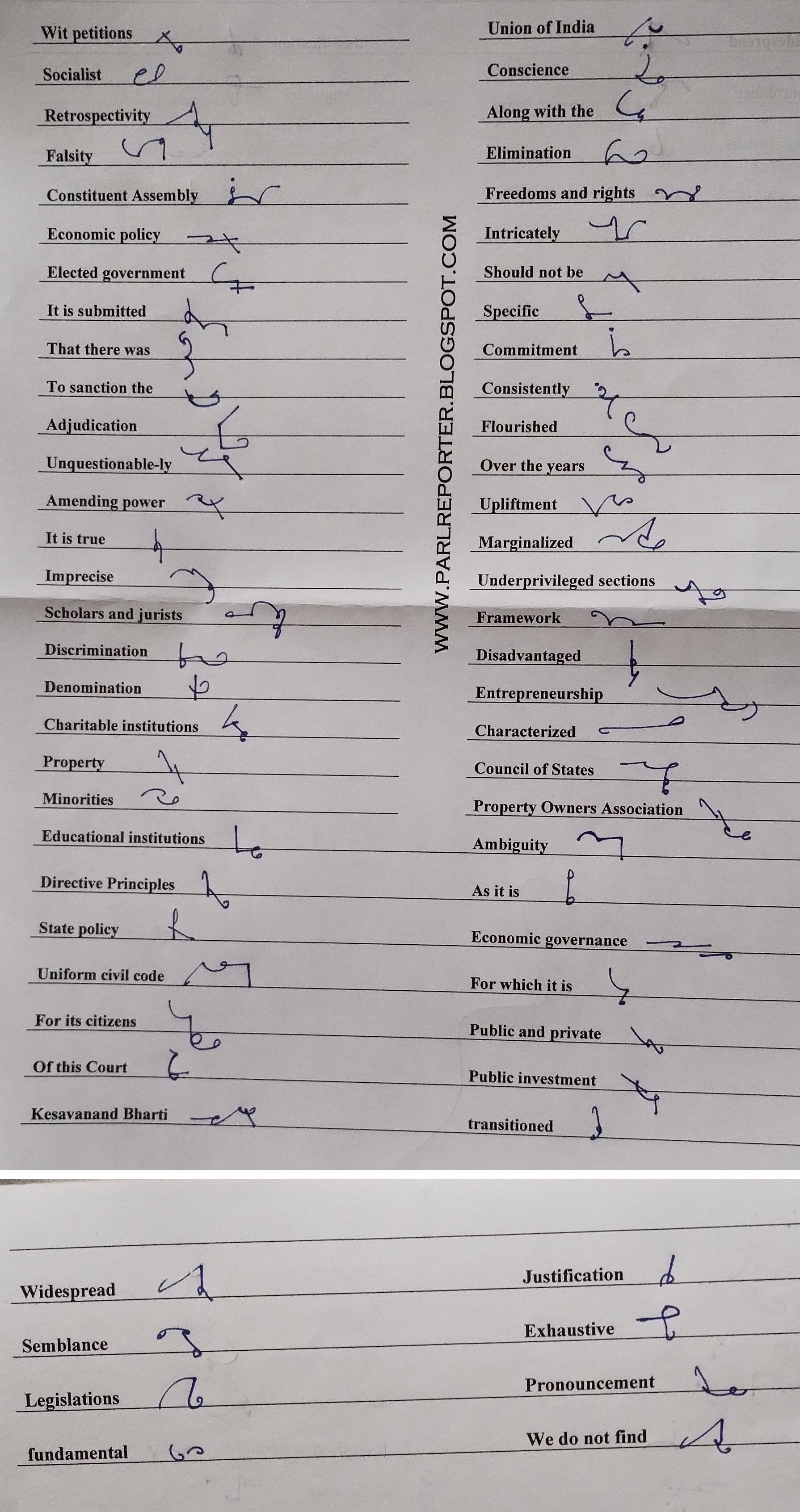
ENGLISH SHORTHND DICTATION-416


These writ petitions seek to challenge the insertion of the words 'socialist' and 'secular' in the Preamble to the Constitution of India by the Constitution (Forty-second Amendment) Act in 1976.

The challenge is on various grounds, namely, retrospectivity of the insertion in 1976, resulting in falsity as the Constitution was adopted on the 26th day of November 1949; the word 'secular' was deliberately eschewed by the Constituent Assembly, and the word 'socialist' restricts the economic policy choice vesting in the elected government, which represents the will of the people. Besides, it is submitted that the Forty-second Amendment is unconstitutional as100 it was 'passed' during the Emergency on November 2, 1976, after the normal tenure of the Lok Sabha that had120 ended on March 18, 1976. Therefore, it is argued, that there was no will of the people to sanction the amendments.

The writ petitions do not require detailed adjudication as the flaws and weaknesses in the arguments are obvious and manifest. Two expressions-'secular' and 'socialist' and the word 'integrity' were inserted in the Preamble vide the Constitution (Forty-second Amendment) Act, 1976. These amendments were made in 1976. Article 368 of the Constitution permits amendment of the Constitution. The power to200 amend unquestionably rests with the Parliament.

This amending power extends to the Preamble. Amendments to the Constitution can be challenged on various grounds, including violation of the basic structure of the Constitution. The fact that the Constitution was adopted, enacted,240 and given to themselves by the people of India on the 26th day of November, 1949, does not make any difference. The date of adoption will not curtail or restrict the power under Article 368 of the Constitution. The retrospectivity argument, if accepted, would equally apply to amendments made to any part of the Constitution, though the power of the300 Parliament to do so under Article 368, is incontrovertible and is not challenged.

While it is true that the Constituent Assembly had not agreed to include the words 'socialist' and 'secular' in the Preamble, the Constitution is a living document, as noticed above with power given to the Parliament to amend it in terms of and in accordance with Article360 368. In 1949, the term 'secular' was considered imprecise, as some scholars and jurists had interpreted it as being opposed to religion. Over time, India has developed its own interpretation of secularism, wherein the State neither supports any religion nor400 penalizes the profession and practice of any faith.

This principle is enshrined in Articles 14, 15, and 16 of the Constitution, which prohibit discrimination against citizens on religious grounds while guaranteeing equal protection of laws and equal opportunity in public employment. The Preamble's original tenets reflect this secular ethos. Article 25 guarantees all persons equal freedom of conscience and the right to freely profess, practice, and propagate religion, subject to public order, morality, health, other fundamental rights, and the State's480 power to regulate secular activities associated with religious practices.

Article 26 extends to every religious denomination the right to establish500 and maintain religious and charitable institutions, manage religious affairs, own and acquire property, and administer such property in accordance with law. Furthermore, Article 29 safeguards the distinct culture of every section of citizens, while Article 30 grants religious and linguistic minorities the right to establish and administer their own educational institutions. Despite these provisions, Article 44 in the Directive Principles of State Policy permits the State to strive for a uniform civil code for its citizens.

A number of decisions of this Court, including the Constitution Bench judgments in the Kesavananda Bharati v. State of Kerala and S. R. Bommai600 vs. Union of India, have observed that secularism is a basic feature of the Constitution.

The State maintains no religion of its own, all persons are equally entitled to freedom of conscience along with the right to freely profess, practice, and propagate their chosen religion, and all citizens, regardless of their religious beliefs, enjoy equal freedoms and rights. However, the 'secular' nature of the State does not prevent the elimination of attitudes and practices derived from or connected with religion, when they, in the larger public interest impede development and the right to equality. In essence, the concept of secularism700 represents one of the facets of the right to equality, intricately woven into the basic fabric that depicts the constitutional720 scheme's pattern.

Similarly, the word 'socialism', in the Indian context should not be interpreted as restricting the economic policies of an elected government of the people's choice at a given time. Neither the Constitution nor the Preamble mandates a specific economic policy or structure, whether left or right. Rather, 'socialist' denotes the State's commitment to be a welfare State and its commitment to ensuring equality of opportunity.

India has consistently embraced a mixed economy model, where the private sector has800 flourished, expanded, and grown over the years, contributing significantly to the upliftment of marginalized and underprivileged sections in different ways. In the Indian framework, socialism embodies the principle of economic and social justice, wherein the State ensures that no citizen840 is disadvantaged. The word 'socialism' reflects the goal of economic and social upliftment and does not restrict private entrepreneurship and the right to business and trade, a fundamental right under Article 19(1)(g).

The word 'secular' was explained as denoting a republic that upholds equal respect for all religions, while 'socialist' was characterized as representing a republic dedicated to eliminating all900 forms of exploitation-whether social, political, or economic. However, the said amendment as proposed to Article 366 was not accepted by the Council of States.

The majority judgment of this Court in the 9-Judge Constitution Bench in Property Owners Association and Others v. State of Maharashtra and Others has cleared any doubt and ambiguity, as it is held that the Constitution,960 as framed in broad terms, allows the elected government to adopt a structure for economic governance which would sub-serve the policies for which it is accountable to the electorate. Indian economy has transitioned from the dominance of public investment to1000 the co-existence of public and private investment.

The fact that the writ petitions were filed in 2020, forty-four years after the words 'socialist' and 'secular' became integral to the Preamble, makes the prayers particularly questionable. This stems from the fact that these terms have achieved widespread acceptance, with their meanings understood by "We, the people of India" without any semblance of doubt. The additions to the Preamble have not restricted or impeded legislations or policies pursued by elected governments, provided1080 such actions did not infringe upon fundamental and constitutional rights or the basic structure of the Constitution.

Therefore, we do1100 not find any legitimate cause or justification for challenging this constitutional amendment after nearly 44 years. The circumstances do not warrant this Court's exercise of discretion to undertake an exhaustive examination, as the constitutional position remains clear, negating the need for a detailed academic pronouncement. This being the clear position, we do not find any justification or need to issue notice in the present writ petitions, and the same are accordingly dismissed.1172


Sunday, 8 December 2024

ENGLISH SHORTHAND DICTATION-415


These appeals arise from the judgment dated 17th August, 2012 rendered by the Division Bench of High Court of Punjab and Haryana whereby, the intra-court appeals preferred by the appellants herein were dismissed and the judgment dated 11th August, 2011 passed by the learned Single Judge of the High Court was upheld. Learned Single Judge rejected the Civil Writ Petitions preferred by the appellants for grant of benefits under the Proficiency Step-up Scheme, 1988 and ACP Scheme, 1998, by accounting for their entire service period including that in the work-charged establishment.

Learned senior counsel appearing on behalf of the appellants,100 vehemently and fervently contended that the Government of Punjab has on its own volition, extended the very same benefits of120 Proficiency Step-up to other employees situated at par with the appellants, and thus, the differential treatment meted out to the appellants tantamount to hostile and subjective discrimination, which is violative of Article 14 of the Constitution of India.

In this regard, learned senior counsel drew the attention of this Court to the Policy Circular dated 13th March, 1996, issued by the Department of Irrigation and Power, Government of Punjab, whereby, it was decided that the Government Policy contained in the200 letter dated 7th May, 1993 would be relaxed and the services of the work-charged staff of Ranjit Sagar Dam would be regularised. He submitted that clause (a) of the said Policy Circular clearly provided that the past services rendered by240 the employees on work-charged or daily basis will be treated as qualifying service for pensionary and all other benefits.

Learned senior counsel further referred to various communications and circulars, more specifically to the Circular dated 12th April, 2005 issued by the Chief Engineer, Irrigation Department, Punjab. Learned senior counsel for the appellants, thus, submitted that the appellants herein are entitled300 to reliefs sought for in these appeals by reversing or modifying the judgment rendered by the learned Single Judge of the High Court as upheld by the learned Division Bench.

During the course of submissions, learned senior counsel for the appellants had restricted the claims of the appellants to the benefits under the Proficiency Step-up Scheme, 1988.

Per contra, learned360 AAG representing the State, vehemently contested the submissions advanced by the counsel for the appellants and urged that the benefits under the Proficiency Step-up Scheme, 1988 to employees situated at par with the appellants herein were extended only in the400 cases where such employees were granted the said relief in compliance of the orders passed by the courts in judicial proceedings. Nonetheless, Shri Irfan was not in a position to dispute the fact that the Circular dated 12th April, 2005 issued by the Chief Engineer, Irrigation Department, Punjab, clearly provides for the grant of Proficiency Step-up to employees of different categories who were left out after the various judgments of the courts, without any court orders being in force qua480 such employees.

We have given our thoughtful consideration to the submissions advanced at the bar and have perused the impugned500 judgments. With the assistance of learned counsel for the parties, we have thoroughly examined the material available on record.

The primary issue that arises for consideration before this Court is whether the service rendered by the appellants herein as work-charged employees prior to regularisation is to be accounted towards the grant of benefits under Proficiency Step-up Scheme, 1988, in view of the fact that other similarly situated employees have already been granted the same benefit.

The fact that the appellants herein were regularised in service and the period spent by them in the work-charged establishment was ordered to be counted600 for qualifying service for pensionary and all other consequential benefits is not in dispute as the same is clearly discernible from the Policy Circular dated 13th March, 1996 referred to supra.

However, a significant bulk of litigation in the form of writ petitions had ensued on behalf of the employees engaged in the work-charged establishment, who claimed that the services rendered by them as work-charged employee should be counted for the grant of benefits under the Proficiency Step-up Scheme, 1988 and the ACP Scheme, 1998 and their claims were accepted by the High Court of Punjab and Haryana but were700 restricted to only the Proficiency Step-up Scheme, 1988.

A perusal of the impugned judgments would reveal that the Division Bench720 treated the Proficiency Step-up Scheme, 1988 and the ACP Scheme 1998 to be at par. On examining the judgments rendered by the learned Single Judge and the Division Bench of the High Court, we find that the precise connotations of the Government Circular dated 1st December, 1988, which had introduced the Proficiency Step-up Scheme were not considered in an apropos manner.

The fundamental distinction in the present case is that the Policy Circular whereby, the services of the appellants were800 regularised, gave a clear mandate that the services of the work-charged employees would be regularised, and the past services of such employees would be treated as qualifying service for pensionary and all other consequential benefits. The High Court seems to840 have overlapped the ACP Scheme, 1998 and the Proficiency Step-up Scheme, 1988 for denying relief to the appellants which is not justifiable by any stretch of imagination.

A writ petition filed by the State against the said order of the Tribunal was dismissed by the Division Bench of the High Court and the SLP preferred challenging the same, has been900 rejected by this Court vide order dated 19th October, 2010. Thereafter, the Irrigation Department of the Government of Punjab vide order dated 9th November, 2010 unconditionally decided to implement the decision of the Tribunal.

In view of discussion made above and in the peculiar facts and circumstances of the instant case, we feel that the differential treatment could not have960 been meted out to the appellants herein who formed a part of the same establishment and were similarly situated to the employees who were granted the benefits under the Proficiency Step-up Scheme, 1988.

Resultantly, we hereby direct that the appellants1000 shall be entitled to have their services in the work-charged establishment counted as qualifying service for Proficiency Step-up in accordance with the Proficiency Step-up Scheme issued vide Government Circular dated 1st December, 1988. The monetary benefits flowing from the above direction shall be paid to the appellants within a period of six months from today.1055


Sunday, 1 December 2024

ENGLISH SHORTHAND DICTATION-414


The appellants are accused nos. 1, 3, 6 and 7 respectively. The appellants have been convicted for the offences punishable under Section 302, read with Section 149 of the Indian Penal Code. The allegation against the appellants is of committing culpable homicide amounting to the murder of one Aslam Khan. The incident is of 3rd February 2013. There were eight accused who were tried for the offence. Out of the eight accused, the Trial Court convicted five. One died during the pendency of the trial.

An appeal against conviction was preferred before the High Court. By the impugned judgment, the100 High Court confirmed the appellants' conviction. However, the High Court set aside the conviction of accused no. 5. The case120 of the prosecution is that accused no. 1 picked up the victim of the offence from his residence at 4 p.m. on the date of the incident and took him to Raja Bazar. The accused killed the victim behind L.P. School by assaulting him with a sharp weapon.

Learned senior counsel appearing for the appellants has taken us through the notes of evidence of the material prosecution witnesses. He pointed out that in paragraph 42 of its judgment, the Trial200 Court held that the claim of PW-1 that he was an eyewitness was fallacious. He pointed out that even evidence of PW-3 needs to be discarded, as his evidence is full of omissions and contradictions. Moreover, he cannot be termed240 an eyewitness.

As far as evidence of PW-4 is concerned, he again submitted that the evidence is not worthy of acceptance, as it is wholly unreliable. He pointed out that evidence of PW-6 shows that there was a prior enmity between her husband and the accused. He pointed out that PW-6 admitted that her husband had lodged a police complaint300 against the accused on the allegation that the accused had dispossessed him from his land.

He submitted that evidence of last seen together in the form of testimony of PW-7 cannot be relied upon. He submitted that the same is true with evidence of PW-9. He pointed out that evidence of PW-10 does not help the prosecution at all. He360 also invited our attention to the evidence of PW-11. He submitted that while recording the cross-examination of the prosecution witnesses, the contradictions had not been properly recorded in accordance with the law.

Learned senior counsel appearing for the State submitted400 that the evidence of prosecution witnesses shows that the deceased was last seen together with the accused. He submitted that coupled with the evidence of last seen together, the motive for the commission of offence had been established. Even otherwise, there is convincing evidence against the appellants. He, therefore, submitted that no fault can be found with the view taken by the High Court.

There is one aspect that was not brought to the notice of this Court, which goes480 to the root of the matter. As can be seen from paragraph 108 of the judgment of the Trial Court,500 the appellants have been convicted for the offence punishable under Section 302 with the aid of Section 149 of IPC. We may note here that ultimately, the High Court held that only four accused were guilty.

Under Section 149 of IPC, every member of an unlawful assembly is guilty of the offences committed in the prosecution of the common object of the unlawful assembly. Therefore, to apply Section 149 of IPC, there has to be an unlawful assembly. Section 141 of IPC defines unlawful assembly as an assembly of five or more persons. The High Court has not held that600 apart from the present appellants whose conviction was confirmed, others formed part of the unlawful assembly.

Hence, there was no unlawful assembly within the meaning of Section 141 of IPC. Therefore, the appellants could not have been convicted for the offence punishable under Section 302 of IPC with the aid of Section 149. The High Court has not modified the charge from Section 302, read with Section 149 of IPC, to Section 302, read with Section 34 of IPC.

Before we deal with the merits, something must be stated about how the trial court recorded the prosecution witnesses' cross-examination in700 this case, especially when they were confronted with their prior statements. The Trial Court did not follow the correct procedure720 while recording the contradictions.

Under Section 161 of the Code of Criminal Procedure, 1973, the police have the power to record statements of the witnesses during the investigation. Section 162 of Code of Criminal Procedure deals with the use of such statements in evidence.

The basic principle incorporated in sub-Section (1) of Section 162 is that any statement made by a person to a police officer in the course of investigation, which is reduced in writing, cannot be used for800 any purpose except as provided in Section 162. The first exception incorporated in sub-Section (2) is of the statements covered by clause (1) of Section 32 of the Indian Evidence Act, 1872. Thus, what is provided in sub- Section (1)840 of Section 162 does not apply to a dying declaration.

The second exception to the general rule provided in sub-Section (1) of Section 162 is that the accused can use the statement to contradict the witness in the manner provided by Section 145 of the Evidence Act. Even the prosecution can use the statement to contradict a witness in the900 manner provided in Section 145 of the Evidence Act with the prior permission of the Court. The prosecution normally takes recourse to this provision when its witness does not support the prosecution case. There is one important condition for using the prior statement for contradiction. The condition is that the part of the statement used for contradiction must be duly960 proved.

When the two statements cannot stand together, they become contradictory statements. When a witness makes a statement in his evidence before the Court which is inconsistent with what he has stated in his statement recorded by the Police, there1000 is a contradiction. When a prosecution witness whose statement under Section 161 (1) or Section 164 of CrPC has been recorded states factual aspects before the Court which he has not stated in his prior statement recorded under Section 161 (1) or Section 164 of CrPC, it is said that there is an omission. 1054


Friday, 8 November 2024

ENGLISH SHORTHAND DICTATION-412


It appears from the record of the Trial Court that after the service of summons on the defendants, they appeared and applied for adjournments for filing the written statement. The first such application was made on 13th December 2001. Subsequent applications were made for adjournments. On 22nd April 2002, the learned trial Judge did not accede to the prayer for grant of further time and passed an order that the suit would proceed ex parte and the date for ex parte hearing was fixed 30th May 2002. At this stage, we may also note that the plaintiffs also made an100 application to strike out the defence of the defendants.

The said application was filed on 18th February 2002. On the120 said application, the Advocate for the plaintiffs made an endorsement in the margin that as there was no advocate representing the defendants, a copy of the application was attached to the said application. Though the date for the ex parte hearing was already fixed as 30th May 2002, on 3rd May 2002, the plaintiffs made an application to the Trial Court for passing an order on the application dated 18th February 2002 for striking out the defendants' defence.

Interestingly, on200 the same day, the plaintiffs moved another application stating that the plaintiffs may be permitted to lead their ex parte evidence through affidavits. It appears that on 3rd May, 2002, the Trial Court allowed the application for striking out the240 defence. Subsequent facts narrated in this judgment would show that the suit was taken on the cause list on that day without any notice to the defendants.

On 16th May, 2002, an application was moved by the defendants for setting aside the order dated 22nd April, 2002. In the application, the averments were made that on 22nd April, 2002, the300 District Judge before whom the suit was pending, was holding a Camp Court at Mussoorie. We may note that the suit was pending in the Court at Dehradun. The contention in the said application was that as the learned District Judge was unavailable, the defendants were under the impression that the suit would not proceed.

In fact, in the affidavit360 filed in support of the said application by one Mukesh Kumar on behalf of the Superintendent of Police, Dehradun, it is stated that he was present on 22nd April 2002 till 4:00 p.m., but the case was not called out.400 On 30th May, 2002, the application for setting aside the order directing the suit to proceed ex parte was rejected. At this stage, we may note here that in the proceedings of 22nd April 2002, it was recorded that on that day, the lawyers had abstained from the Court work, and the learned Presiding Judge was on a tour of Mussoorie for holding a camp.

There is no mention in the proceedings of 22nd April, 2002 that any in charge480 Judicial Officer passed an order to proceed with the suit ex parte. To the specific allegations made by the defendants500 in the application for setting aside the ex parte order that the Judicial Officer was not available, in the reply filed by the plaintiffs in paragraph 4, all that is stated is that the contentions that on 22nd April, 2002, the learned District Judge had proceeded to Mussoorie, are misconceived and the provisions of the Assam and Agra Civil Courts Act are apparent in this respect.

On 1st July, 2002, the defendants applied for setting aside the order dated 3rd May, 2002 by which their defence was struck out. The application proceeds on the allegation that on 3rd May, 2002,600 the Court proceeded to strike out the defendants' defence without giving them an opportunity of being heard and the hearing was conducted ex parte. Very interestingly, a reply was filed to the said application by the plaintiffs in which a stand has been taken that as the suit was directed to proceed ex parte, there was no occasion to give an intimation to the defendants or their counsel that the application will be taken up on 3rd May, 2002.

Therefore, it is an accepted position that the application for striking out the defence of the defendants was taken up on700 the cause list on 3rd May 2002 without issuing notice to the defendants, though on 22nd April, 2002, the next720 date was already fixed as 30th May 2002. The application for setting aside the order dated 3rd May, 2002 was rejected. At this stage, we must clarify the legal position. Even if a defendant does not file a written statement and the suit is ordered to proceed ex parte against him, the limited defence available to the defendant is not foreclosed.

A defendant can always cross-examine the witnesses examined by the plaintiff to prove the falsity of the plaintiff's case.800 A defendant can always urge, based on the plaint and the evidence of the plaintiff, that the suit was barred by a statute such as the law of limitation. Therefore, notwithstanding an order passed earlier to proceed ex parte, while840 deciding an application for striking out the defence, it was the duty of the Court to give an opportunity of being heard to the defendants. However, that was not done.

As the suit was fixed on 30th May, 2002, the defendants were entitled to a notice that the suit would be taken up on an earlier date for hearing the900 application for striking out the defence. When the defendants had appeared in the suit, the act of preponing the date without notice to them or their advocate was completely illegal and contrary to elementary principles of natural justice. Therefore, it follows that the order striking out the defendants' defence is completely illegal, and the said order deserves to be set960 aside.

There is something further which must be noted. As can be seen from the record, the plaintiffs moved an application on 2nd August, 2002 to amend the description of the suit property. The endorsement on the application records that1000 'the case is proceeding ex parte against the defendants'. Therefore, a copy of the said application was not served upon the defendants. As seen from the proceedings, the application was allowed on 2nd August, 2002. Thereafter, the suit was decreed on 24th August, 2002.

It is true that before the application for amendment of the plaint was allowed, the defendants' defence was already struck out. Even if the defendants' defence was struck out, the defendants were entitled to a copy1080 of the amended plaint. What was struck out was the right to defend the suit as unamended. Whether the subsequent1100 plaint will affect the earlier order of striking out the defence will depend upon the nature of the amendment. However, even a copy of the amended plaint was not served on the defendants.

The defendants challenged the ex parte decree by filing a statutory revision application under Section 25 of the Provincial Small Cause Courts Act, 1887, before the learned Single Judge of the High Court. By the impugned judgment, the learned Single Judge rejected the said revision application without1180 noticing the glaring facts borne out from the record.


----------------------------------------------------------------------------------------------------------------------   

THE PITMAN DICTIONARY OF ENGLISH AND SHORTHAND

https://amzn.to/4ec1f8n


PITMAN’S SHORTHAND DICTIONARY

https://amzn.to/3Cl3s3Y


PITMAN POCKET SHORTHAND DICTIONARY

https://amzn.to/48wXyc2


English Shorthand Magazine (Guide to High Sped Writing Based on Pitman English Shorthand) Combined Volume 37

https://amzn.to/3NQUaiQ


Shorthand through Phonetics [Pitman Made Easy]

https://amzn.to/4f7aPeb


Legal English Shorthand Magazine (Set -1) 

 https://amzn.to/4f9IpjC  


High Speed Shorthand-English Dictation Books (7 Volumes)

https://amzn.to/4efF01x


Sunday, 27 October 2024

ENGLISH SHORTHAND DICTATION-411


The case of the prosecution in brief is that the appellant had a land dispute with the deceased. The allegation against the appellant is that on 2nd March 2013, he assaulted the deceased. After that, he caught hold of the deceased by her hair and dragged her up to the village pond. The appellant put her head inside the pond water. The deceased was suffocated to death.

The first informant-Raman, PW-4, informed the police that Himani Devi died due to drowning. Accordingly, an FIR was registered. After the completion of the investigation, a chargesheet was filed against the appellant. The100 prosecution examined ten witnesses. There is no direct evidence. The prosecution relied upon evidence of PW-1, Saloni Devi, the village120 officer.

The prosecution case is that the appellant made an extra-judicial confession before the witness. The prosecution relied upon the evidence of PW-5, Chaprasi, the brother of the deceased. According to PW-5, he saw the appellant holding the hair of the deceased and was taking her towards the pond. Though PW-1 was declared hostile, the Trial Court and High Court relied upon a part of her testimony. The Courts also believed the testimony of PW-5.

The learned counsel appearing for200 the appellant as amicus curiae, has taken us through the postmortem report and testimony of relevant prosecution witnesses. Based on the evidence of PW-9, Dr. Ram Kumar, his submission is that the death was due to drowning, and the prosecution240 has not discharged the burden on it to prove that it was a homicidal death. He submitted that evidence of PW-1, who was declared as hostile, cannot be believed as in the examination-in-chief, the witness did not depose that the appellant made a confession of killing the deceased. However, in the cross-examination made by the public prosecutor, the witness purportedly300 stated that the appellant confessed before her about killing the deceased. He submitted that evidence of PW-1 cannot be believed. As regards the evidence of PW-5, he stated that though the witness deposed that he saw the appellant dragging the deceased towards the pond, PW-2 - Bala, who was allegedly present at that time, did not support the prosecution.

Moreover,360 another witness, Lakhan, was allegedly present there and was not examined by the prosecution. He pointed out that the incident happened in the evening and PW-10, Investigating Officer admitted that there is a temple near the house of the deceased400 and other people lived nearby. He would, therefore, submit that the prosecution has failed to prove the appellant's guilt beyond a reasonable doubt.

The learned counsel appearing for the respondent State, submitted that in her cross-examination made by the public prosecutor, PW-1 has clearly deposed about the confessional statement made by the appellant. He submitted that evidence of a hostile witness need not be rejected in its entirety and that the Court can always rely upon a part of the480 testimony of such a witness.

He submitted that the evidence of PW-5 proves that the appellant was last seen together500 with the deceased, and at that time, he was holding the deceased by her hair. He submitted that this evidence is sufficient to hold that the death of the deceased is homicidal. He submitted that in view of the oral testimony of the said two witnesses, the appellant's guilt has been established.

We have carefully perused the evidence of prosecution witnesses and other documents on record. The prosecution is relying upon the extra-judicial confession made by the appellant before PW-1 and evidence of PW-5 of last seen together. The case of the prosecution is that after an altercation with the600 deceased in her house, the appellant held the deceased by her hair and dragged her to the village pond. The prosecution is relying upon a site map.

It shows that a road separates the pond and the house of the deceased. The sketch shows the existence of a ridge around the pond and two temples on the ridge of the pond abutting the road. The temples are exactly opposite the house of the deceased. According to the prosecution case, the appellant dragged the deceased by holding her hair from her house up to the pond. Between the house of the700 deceased and the pond, there is a road and ridge of the pond.

This means the appellant must have dragged720 the deceased for a considerable distance. The postmortem report records explicitly that no marks of any injury were found on the body of the deceased. In his evidence, PW-9 Dr. Ram Kumar reiterated that there was no injury mark on the body of the deceased. If the prosecution story of the appellant dragging the deceased was true, there would have been some injury on the body of the deceased. Therefore, the absence of any injury marks on the body militates800 against the prosecution's case.

Evidence of PW-9 shows that salt water was found in the trachea and lungs of the deceased. Perhaps to find out whether the water found in the trachea and lungs of the deceased was the water840 in the pond, samples of water from the pond were collected and sent to the laboratory. That is what PW-10, the Investigating Officer, has stated in paragraph 11 of his deposition. He further stated that the Director of the State Judicial Laboratory returned the samples without testing them on the ground that the cause of death was established in the900 postmortem notes.

According to PW-9, the cause of death was due to drowning. However, he was unable to state whether the death was homicidal or accidental. The reason is that it was difficult for him to state whether deceased immersed in water herself or she was forced into water. In fact, in postmortem notes, PW-9 stated that an expert's opinion960 should be sought. Admittedly, an expert's opinion was not sought.

Now, we turn to evidence of PW-1. She was a village Kotwal. She was a signatory to the panchnama of the recovery of the dead body and a signatory to1000 the sketch of the site made by the police. In the examination-in-chief, she stated that on the date of the incident, around 7 p.m., the appellant came to her house and stated that his mother had died. She has not deposed in her examination-in-chief that the appellant stated that he had killed the deceased.

A Statement under Section 161 of the Code of Criminal Procedure, 1973 of the witness was recorded by the police. Obviously, as the said witness made1080 a departure from what she had stated in the police statement, at the instance of the public prosecutor, the witness1100 was declared hostile. The cross-examination of the witness by the public prosecutor shows that the witness was not confronted by showing the relevant part of her statement recorded under Section 161 of Code of Criminal Procedure.

The witness ought to have been confronted with her prior statement in accordance with Section 145 of the Indian Evidence Act. However, in the cross-examination made by the public prosecutor, the witness accepted the suggestion given by the public prosecutor that the appellant came to her house at 7 p.m. on the date of the incident and told her that he had killed his1200 stepmother by putting her head into the village pond.


THE PITMAN DICTIONARY OF ENGLISH AND SHORTHAND

https://amzn.to/4ec1f8n


PITMAN’S SHORTHAND DICTIONARY

https://amzn.to/3Cl3s3Y


PITMAN POCKET SHORTHAND DICTIONARY

https://amzn.to/48wXyc2

Sunday, 29 September 2024

ENGLISH SHORTHAND DICTATION-409


We have heard the learned counsel in support of the appeal and the Additional Solicitor General for the respondent. The submission of the appellant is that in concluding that the deceased was not travelling in the train on 5th September 2003, both the High Court and the Tribunal have overlooked the findings contained in the final report dated 6th November 2023 submitted by the Investigating Officer to the Sub-Divisional Magistrate. According to the submission, the above report also includes an extract from the post-mortem report which indicated that the cause of death was due to head injuries resulting from a100 "blunt force impact". The estimated time of death was determined to be between forty-eight and seventy-two hours before the120 conduct of the post-mortem.

In support of the claim that compensation ought to be awarded to the appellant, the learned counsel submitted that it is not necessary to produce a valid ticket to claim compensation under Section 124A of the Railways Act 1989, in view of the decision in Union of India vs. Rina Devi. The law laid down by this Court in successive decisions has clarified the test by which the amount of compensation under the Railways Act must200 be computed, including the entitlement of the claimant in case of an increase in the permissible amount. He submitted that the appellant should be awarded interest as admissible in law.

In response, the respondent argued that the appellant had not240 provided a reason for the delay in the discovery of the body of the deceased. It argued that other employees of the Railways were bound to have chanced upon the body in the days after the alleged date of death. It supported the judgments of the Tribunal and the High Court.

Written submissions have been submitted on behalf of the300 appellant as well as the respondent. Before turning to the issue at hand, it is necessary to briefly advert to the judgments of the Tribunal and the High Court. The Tribunal framed three important issues for consideration. First issue was whether the deceased was a bona fide passenger of the train in question on the date of incident. Second issue360 was whether the incident as alleged in the claim application took place and was covered within the definition of an untoward incident under Section 123(c) of the Railways Act. Third issue was whether the appellant was entitled to compensation, and400 what the relief should be, if any.

The appellant deposed in support of the claim, together with her cousin, Deepak. Both witnesses were cross-examined. The railways did not produce either oral or documentary evidence. After considering the material on record and hearing the parties, the Tribunal found that no ticket was found with the deceased, whose body was found on 8th September 2003. Neither the appellant nor her cousin was eye witness to the death. There was nothing else on480 record to show that the deceased boarded the train. The Tribunal also found that the appellant was required to produce500 the best evidence but did not do so. The report of the Investigating Officer was not sufficient to rebut the presumption under Section 191 of the Railways Act.

The Tribunal concluded that there was no evidence to prove that the deceased died as a consequence of falling off the train. It found that compensation was therefore not payable to the appellant. It later dismissed the application for review of its judgment on the ground that no new facts were placed on record which would warrant a review. The Tribunal also observed that the secret witnesses examined by the Investigating Officer600 were not examined.

On appeal, the High Court dismissed the appeal against the decision of the Tribunal. By its judgment dated 7th January 2014, the High Court held that from the material available on record, it appeared that the body of the deceased was found lying near the railway track. However, nothing on record indicated that the deceased was travelling as a passenger on the train. The post-mortem report indicated that the death took place between forty-eight and seventy-two hours before the conduct of the post-mortem, which was on 9th September 2003 at 1:30 pm. From this, it cannot conclusively700 be held that the deceased died on 5th September 2003. The Court held that the report filed by the Investigating720 Officer is not supported by substantive material. Since he had no personal knowledge regarding the cause of death, his report cannot be accepted as evidence of the fact that the deceased was travelling as a passenger on the train in question. The Court therefore concluded that the appellant failed to establish that the deceased was travelling as a passenger on 5th September 2003 on the train in question.

The High Court later dismissed the review petition preferred by the appellant.800 It held that the material facts as well as the questions of law had been considered in the judgment under review; and the report of the Investigating Officer was based on a "secret enquiry" conducted by him. The Investigating Officer840 did not disclose the material facts which led him to conclude that the deceased was travelling in the train. Further, he was not examined. The opinion of the Investigating Officer, as recorded in his report, was therefore not substantiated. Therefore, the High Court concluded that the appellant had not made out a case that there was an error apparent on900 the face of the record.

From the recapitulation of the various judicial pronouncements leading to the present appeal, it can be seen that the primary issue is whether the deceased was travelling on the train in question. In Union of India v Rina Devi, a two-Judge Bench of this Court considered the question of the party on which the burden960 of proof will lie in cases where the body of the deceased is found on railway premises. This Court held that the initial burden would be on the claimant, which could be discharged by filing an affidavit of the relevant1000 facts. Once the claimant did so, the burden would then shift to the Railways. Significantly, it also held that the mere absence of a ticket would not negate the claim that the deceased was a bona fide passenger.

In the present case, the appellant had duly filed an affidavit stating the facts and adverting to the report arising from the investigation conducted by the respondent, which showed that the deceased was travelling on the train and that his death was1080 caused by a fall during the course of his travel. The burden of proof then shifted to the Railways, which1100 has not discharged its burden. Therefore, the presumption that the deceased was a bona fide passenger on the train in question was not rebutted.

Further, the report of the Investigating Officer indicates the details mentioned in the post-mortem report. It states that the cause of death was due to an injury sustained on the head and that all injuries were antemortem and caused by "blunt force impact". It also states that forty-eight to seventy-two hours had passed since the time of death.1182


English Shorthand Magazine (Guide to High Sped Writing Based on Pitman English Shorthand) Combined Volume 37

https://amzn.to/3NQUaiQ


Shorthand through Phonetics [Pitman Made Easy]

https://amzn.to/4f7aPeb


Legal English Shorthand Magazine (Set -1) 

 https://amzn.to/4f9IpjC  


High Speed Shorthand-English Dictation Books (7 Volumes)

https://amzn.to/4efF01x


Saturday, 28 September 2024

ENGLISH SHORTHAND DICTATION-408


The first submission of the learned counsel for the appellant is that the charge framed against the appellant and accused no.1 was only for the offence punishable under Section 22(c) of the NDPS Act. The allegation, as stated in the charge, was that on 21st December 2013, the appellant and accused no.1 gave cartons of Fortwin injections for interstate transportation without any valid licence and in contravention of Section 8(c) of the NDPS Act. He submitted that no charge was framed against the appellant for the offence punishable under Section 29 of the NDPS Act.

He submitted that the finding100 of the High Court is that the appellant has been prosecuted and convicted for having sold contraband to an unauthorised120 person, leading to the presumption that the contraband was sold to be used as an intoxicant. He submitted that there is no evidence to show that the contraband contained in the consignment booked by the accused no.1 was purchased from the appellant. He submitted that the Courts have placed reliance on the statement of the appellant recorded under Section 67 of the NDPS Act, which is not admissible in evidence as held by this Court in the case of Toofan200 Singh v. State of Tamil Nadu.

He submitted that apart from prejudice caused to the appellant on account of non-framing of proper charge, the allegation of conspiracy under Section 29 of the NDPS Act was not put to the appellant240 in his statement recorded under Section 313 of the Code of Criminal Procedure, 1973. He submitted that unless a charge of conspiracy under Section 29 was proved, the appellant could not be punished under Section 22(c) of the NDPS Act.

The learned senior counsel appearing for the respondent submitted that the accused no.3, who examined himself as a defence witness, 300 placed on record invoices issued to the appellant for sending the Fortwin injections. She submitted that the fact that 30 cartons of Fortwin injections were supplied by accused no.3 at the instance of the appellant has been established through evidence. She submitted that there is enough evidence on record to show that the contraband was supplied to accused no.1 at360 the instance of the present appellant by the accused no.3.

We have perused the notes of evidence and considered the submissions. Under Section 8(c), there is a complete prohibition on possessing and transporting any narcotic drug or psychotropic substance. In400 this case, the contravention involves commercial quantity, for which there is no dispute. Section 22 is attracted when, in contravention of any provisions of the NDPS Act, anyone possesses or transports a psychotropic substance. In the facts of the case, the consignment was booked by accused no.1, and therefore, he was found to be transporting the psychotropic substance in contravention of Section 8(c) of the NDPS Act. There is no allegation against the appellant of transporting the contraband. The consignment480 was booked in the name of the accused no.1 as per the prosecution case. Therefore, unless it is proved that500 the appellant had supplied the consignment to accused no.1 or was a part of a criminal conspiracy to commit an offence under Section 22(c), the appellant cannot be punished.

Perusal of the evidence of accused no.3, who was examined as a defence witness, shows that he was carrying on the business of M/s Renuka Medicals in his wife's name. He stated that he issued invoices for sending Fortwin injections to the appellant. However, there is no evidence on record to show that accused no.3 procured the contraband that is the subject matter of the prosecution and handed it over to600 the appellant or accused no.1.

We may note that the Trial Court and High Court have relied upon the appellant's statement under Section 67 of the NDPS Act. Therefore, the appellant's statement recorded under Section 67 of the NDPS Act is not admissible in evidence and cannot be read in evidence.

The High Court, in paragraph 37 of the impugned judgment, has noted that a statement of the transporter ought to have been recorded to prove that the delivery of consignment containing contraband was made by accused no.3 to the appellant's shop. In fact, the person who allegedly transported the700 contraband from accused no.3 to the appellant was a crucial witness.

However, the prosecution has withheld the evidence of this720 witness from the Court. Hence, an adverse inference must be drawn against the prosecution. In the statement of accused no.1, under Section 67 of the NDPS Act, he stated that he purchased Fortwin injections from the appellant and one Arun Singh several times. However, no investigation has been carried out against Arun Singh.

There is no recovery from the appellant of any incriminating material. There is no evidence to show that the contraband tried to be transported by accused no.1800 by railway parcel was delivered by or on behalf of the appellant to accused no.1. There is no evidence of any conspiracy against the appellant. Therefore, the respondent has not established the offences punishable under Sections 22(c) and 29 of840 the NDPS Act against the appellant beyond a reasonable doubt.

In the charge, there is no reference to the allegation of commission of an offence under Section 29 of the NDPS Act. However, it is not necessary for us to go into the question of whether non-framing of charge under Section 29 of the NDPS Act has resulted in the900 failure of justice. The reason is that there is absolutely no legal evidence on record to show that the contraband attempted to be transported by accused no.1 by a railway parcel was supplied to him by the appellant. There is no evidence of the appellant's participation in any conspiracy. Therefore, the conviction of the appellant cannot be sustained.958


English Shorthand Magazine (Guide to High Sped Writing Based on Pitman English Shorthand) Combined Volume 37

https://amzn.to/3NQUaiQ


Shorthand through Phonetics [Pitman Made Easy]

https://amzn.to/4f7aPeb


Legal English Shorthand Magazine (Set -1) 

 https://amzn.to/4f9IpjC  


High Speed Shorthand-English Dictation Books (7 Volumes)

https://amzn.to/4efF01x