Showing posts with label Pitman English Shorthand. Show all posts

Tuesday, 24 December 2024

ENGLISH SHORTHND DICTATION-416


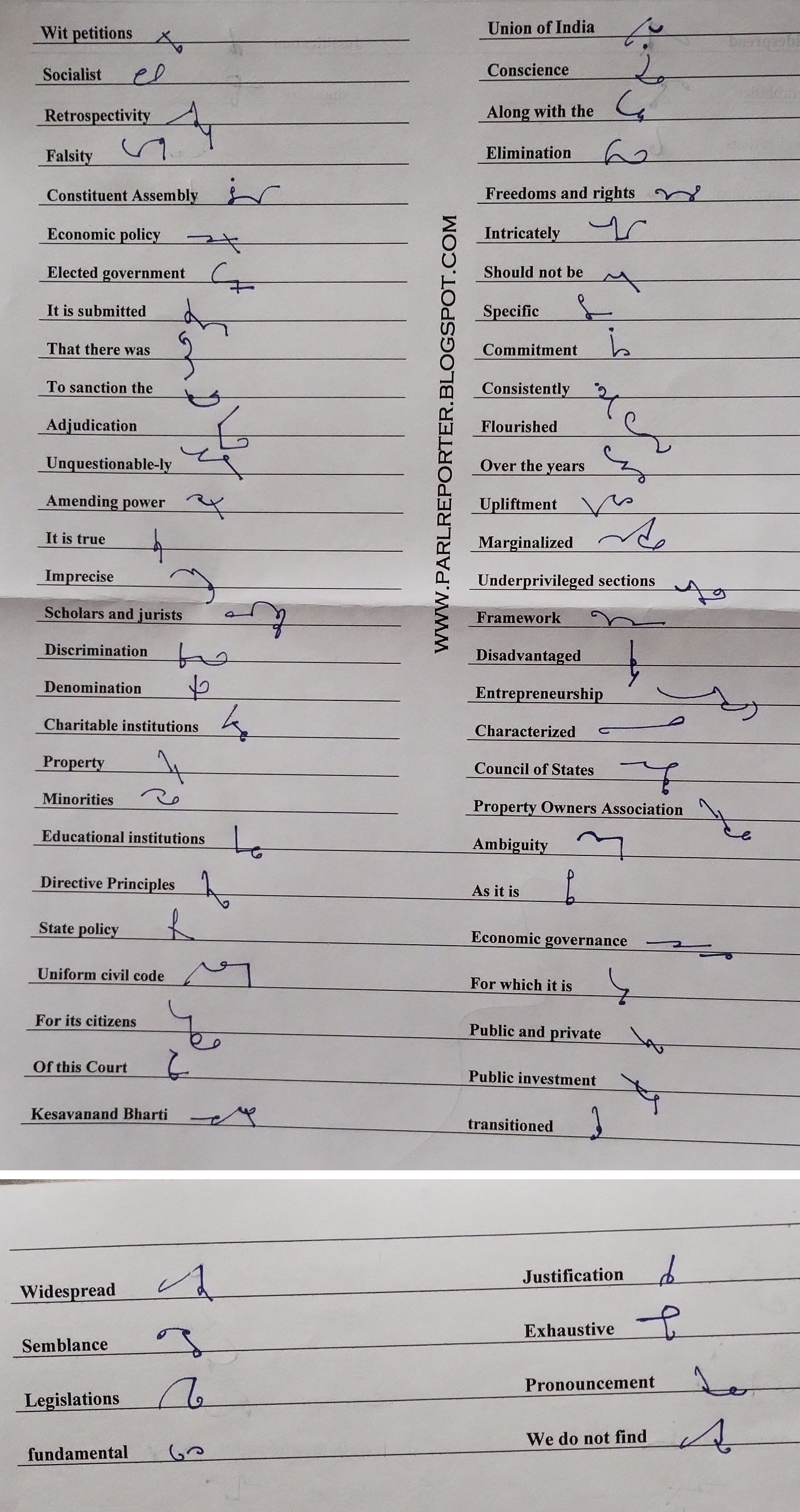
These writ petitions seek to challenge the insertion of the words 'socialist' and 'secular' in the Preamble to the Constitution of India by the Constitution (Forty-second Amendment) Act in 1976.

The challenge is on various grounds, namely, retrospectivity of the insertion in 1976, resulting in falsity as the Constitution was adopted on the 26th day of November 1949; the word 'secular' was deliberately eschewed by the Constituent Assembly, and the word 'socialist' restricts the economic policy choice vesting in the elected government, which represents the will of the people. Besides, it is submitted that the Forty-second Amendment is unconstitutional as100 it was 'passed' during the Emergency on November 2, 1976, after the normal tenure of the Lok Sabha that had120 ended on March 18, 1976. Therefore, it is argued, that there was no will of the people to sanction the amendments.

The writ petitions do not require detailed adjudication as the flaws and weaknesses in the arguments are obvious and manifest. Two expressions-'secular' and 'socialist' and the word 'integrity' were inserted in the Preamble vide the Constitution (Forty-second Amendment) Act, 1976. These amendments were made in 1976. Article 368 of the Constitution permits amendment of the Constitution. The power to200 amend unquestionably rests with the Parliament.

This amending power extends to the Preamble. Amendments to the Constitution can be challenged on various grounds, including violation of the basic structure of the Constitution. The fact that the Constitution was adopted, enacted,240 and given to themselves by the people of India on the 26th day of November, 1949, does not make any difference. The date of adoption will not curtail or restrict the power under Article 368 of the Constitution. The retrospectivity argument, if accepted, would equally apply to amendments made to any part of the Constitution, though the power of the300 Parliament to do so under Article 368, is incontrovertible and is not challenged.

While it is true that the Constituent Assembly had not agreed to include the words 'socialist' and 'secular' in the Preamble, the Constitution is a living document, as noticed above with power given to the Parliament to amend it in terms of and in accordance with Article360 368. In 1949, the term 'secular' was considered imprecise, as some scholars and jurists had interpreted it as being opposed to religion. Over time, India has developed its own interpretation of secularism, wherein the State neither supports any religion nor400 penalizes the profession and practice of any faith.

This principle is enshrined in Articles 14, 15, and 16 of the Constitution, which prohibit discrimination against citizens on religious grounds while guaranteeing equal protection of laws and equal opportunity in public employment. The Preamble's original tenets reflect this secular ethos. Article 25 guarantees all persons equal freedom of conscience and the right to freely profess, practice, and propagate religion, subject to public order, morality, health, other fundamental rights, and the State's480 power to regulate secular activities associated with religious practices.

Article 26 extends to every religious denomination the right to establish500 and maintain religious and charitable institutions, manage religious affairs, own and acquire property, and administer such property in accordance with law. Furthermore, Article 29 safeguards the distinct culture of every section of citizens, while Article 30 grants religious and linguistic minorities the right to establish and administer their own educational institutions. Despite these provisions, Article 44 in the Directive Principles of State Policy permits the State to strive for a uniform civil code for its citizens.

A number of decisions of this Court, including the Constitution Bench judgments in the Kesavananda Bharati v. State of Kerala and S. R. Bommai600 vs. Union of India, have observed that secularism is a basic feature of the Constitution.

The State maintains no religion of its own, all persons are equally entitled to freedom of conscience along with the right to freely profess, practice, and propagate their chosen religion, and all citizens, regardless of their religious beliefs, enjoy equal freedoms and rights. However, the 'secular' nature of the State does not prevent the elimination of attitudes and practices derived from or connected with religion, when they, in the larger public interest impede development and the right to equality. In essence, the concept of secularism700 represents one of the facets of the right to equality, intricately woven into the basic fabric that depicts the constitutional720 scheme's pattern.

Similarly, the word 'socialism', in the Indian context should not be interpreted as restricting the economic policies of an elected government of the people's choice at a given time. Neither the Constitution nor the Preamble mandates a specific economic policy or structure, whether left or right. Rather, 'socialist' denotes the State's commitment to be a welfare State and its commitment to ensuring equality of opportunity.

India has consistently embraced a mixed economy model, where the private sector has800 flourished, expanded, and grown over the years, contributing significantly to the upliftment of marginalized and underprivileged sections in different ways. In the Indian framework, socialism embodies the principle of economic and social justice, wherein the State ensures that no citizen840 is disadvantaged. The word 'socialism' reflects the goal of economic and social upliftment and does not restrict private entrepreneurship and the right to business and trade, a fundamental right under Article 19(1)(g).

The word 'secular' was explained as denoting a republic that upholds equal respect for all religions, while 'socialist' was characterized as representing a republic dedicated to eliminating all900 forms of exploitation-whether social, political, or economic. However, the said amendment as proposed to Article 366 was not accepted by the Council of States.

The majority judgment of this Court in the 9-Judge Constitution Bench in Property Owners Association and Others v. State of Maharashtra and Others has cleared any doubt and ambiguity, as it is held that the Constitution,960 as framed in broad terms, allows the elected government to adopt a structure for economic governance which would sub-serve the policies for which it is accountable to the electorate. Indian economy has transitioned from the dominance of public investment to1000 the co-existence of public and private investment.

The fact that the writ petitions were filed in 2020, forty-four years after the words 'socialist' and 'secular' became integral to the Preamble, makes the prayers particularly questionable. This stems from the fact that these terms have achieved widespread acceptance, with their meanings understood by "We, the people of India" without any semblance of doubt. The additions to the Preamble have not restricted or impeded legislations or policies pursued by elected governments, provided1080 such actions did not infringe upon fundamental and constitutional rights or the basic structure of the Constitution.

Therefore, we do1100 not find any legitimate cause or justification for challenging this constitutional amendment after nearly 44 years. The circumstances do not warrant this Court's exercise of discretion to undertake an exhaustive examination, as the constitutional position remains clear, negating the need for a detailed academic pronouncement. This being the clear position, we do not find any justification or need to issue notice in the present writ petitions, and the same are accordingly dismissed.1172


Sunday, 5 May 2024

ENGLISH SHORTHAND DICTATION-396


Madam Speaker, I rise to join all Members of this august House in conveying our sincere thanks to hon. President for his enlightened Address. The debate on the President's Address has been vigorous and wide ranging. I thank all the hon. Members who have contributed to this debate. Madam, as hon. President mentioned in the initial parts of his Address, our economy has faced a difficult situation in the past one year. Hon. Members are aware that our growth has slowed down and the fiscal deficit has risen. Inflation has been a persistent problem in the last two years. The100 Current Account Deficit is substantially higher than what we would like it to be. The Finance Minister has dealt with120 all these issues in his Budget speech, and before that the Economic Survey tabled in this House gave a fairly comprehensive picture of the state of economy. I would therefore be brief in speaking about the challenges that confront our economy and what we need to do to overcome them. However, Madam, I do wish to emphatically endorse the view of the Finance Minister that the slowdown in the economy need not persist, and that we are fully capable of200 putting the country back on a high growth path of 7 to 8 per cent per annum in the next two to three years. To achieve this, we need to increase the rate of investment, especially in infrastructure. Our effort,240 therefore, will be to raise domestic savings, contain the growth of subsidies and encourage private investment. While our aim is to achieve an average GDP growth of 8 per cent during the 124 Plan and agricultural growth of 4 per cent, the focus will continue to remain on inclusive growth. Inclusive growth implies not only reducing poverty, but300 also improving regional equality across and within States, uplift of the Scheduled Castes, Scheduled Tribes, Other Backward Classes and minorities, closing gender gaps and generating more and better employment opportunities. Our policies have been designed to fulfil these objectives.

Madam, with regard to poverty, in the UPA Period, poverty declined at an average rate of two per cent per annum.360 In the preceding ten years, the rate of decline was no more than 0.8 per cent. With regard to regional inequalities, inter-State growth differential has narrowed and inter-State inequality is not increasing. The so-called backward States have also400 done much better in the UPA Period than was the case previously. In terms of education and skill development also, the achievements of the UPA Government are really notable. The key instruments for promoting inclusiveness and empowerment are education, health and skill development. There has been near universal enrolment in primary schools and a steady increase in average number of years of schooling of the labour force.

Madam, it is not my case that what we have achieved is the500 optimum level. I do recognise that growth requires further efforts to boost it. We need to do lot more to promote inclusiveness, health and education require greater attention, and environment protection measures have to be adopted with greater amount of firmness. But I would respectfully submit to this august House that what has been achieved is not something which can be belittled as Shri Rajnath Singh tried to do. I know that BJP has a particular view towards the economic and social policy of the UPA. A few days ago, a conclave of the National Council of BJP assembled in600 Delhi used the choicest abuses for the Congress establishment and Congress leadership including myself. It is not my intention to reply them in that language because I do believe that our work and our performance are the best judges of what we have achieved. We have seen this arrogance not for the first time. The Shining India campaign in 2004 led to disastrous results for the BJP. In 2009, they fielded the iron man Shri Advani against the lamb that Dr. Manmohan Singh is, and we know what the result was. I am convinced that if700 the people of India were to look at our record in these nine or ten years, they would repeat what720 they did in 2004 and 2009. Madam, several hon. Members have expressed concern about the state of agriculture. I share that concern. Farmers in our country are the most important constituent that the UPA cares for. We have done utmost to give our farmers remunerative prices, and here I would like to mention that the procurement prices of wheat, rice and other products have been raised in a manner which was never seen before in the800 history of this country.

Madam, several hon. Members, cutting across party lines, have expressed concern over incidents of violence against women. This is an issue, which unites all sections of the House, and I sincerely appeal to all sections of840 the House to speak with one voice. If there are any legislative measures, which we can agree upon, they can be then pushed forward at a much higher speed than is normally done when it comes to legislation through Parliament. I sincerely hope that we will agree to go forward in a manner which will do justice to 50 per900 cent of India’s population, that is, our women and children. Let me reiterate to this august House the commitment of our Government to ensuring the dignity, safety and security of every woman of this country. We have adopted a series of measures- legislative, institutional and procedural, which reaffirm the collective responsibility of this Government in this direction as more and960 more women enter public spaces. The Government has been prompt in acting on the recommendations of the Justice Verma Committee, by promulgating an Ordinance amending and strengthening the law to deal with crimes of sexual violence against women.998


Friday, 12 April 2024

ENGLISH SHORTHAND DICTATION-387


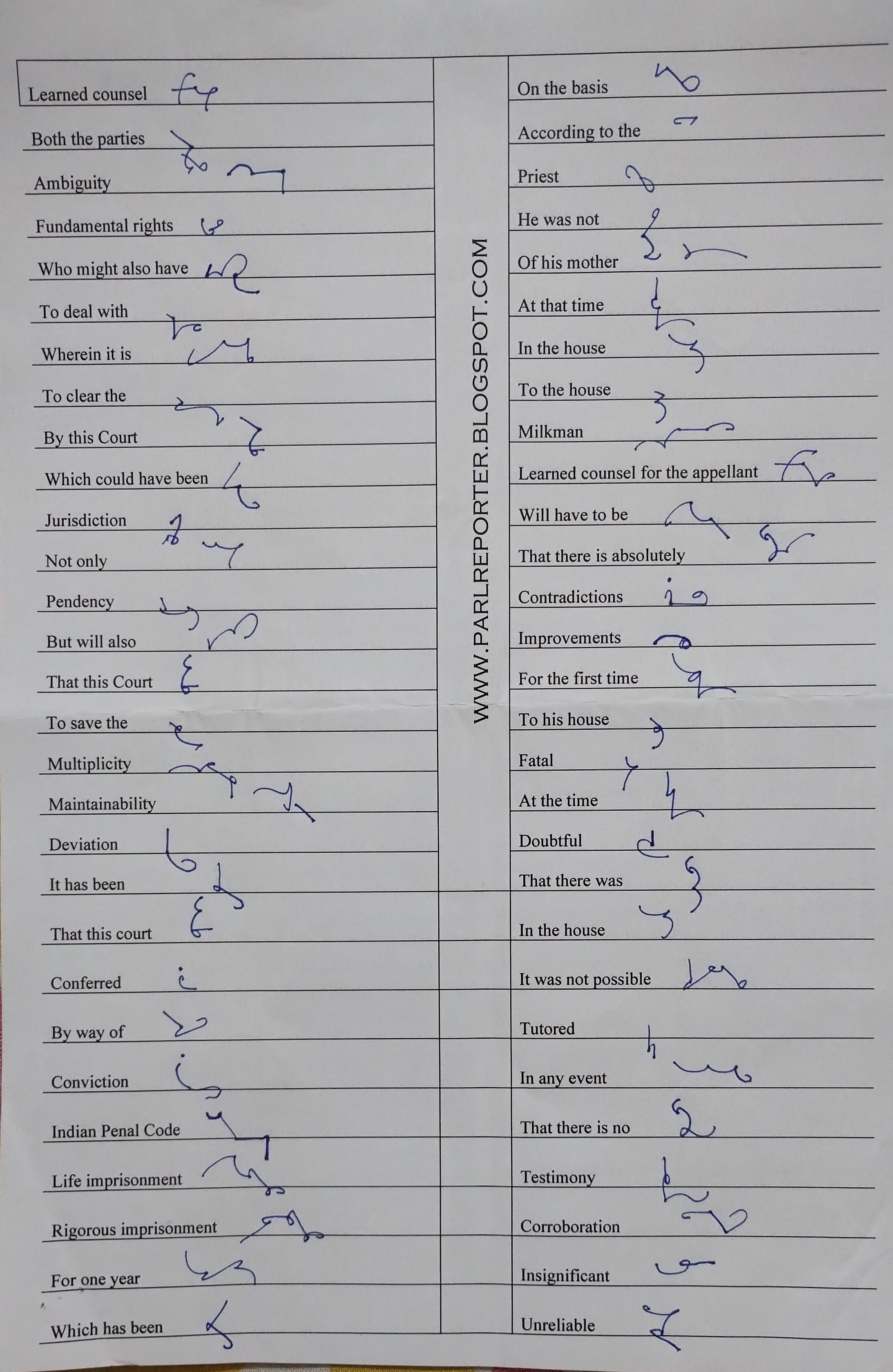
The learned counsels appearing on behalf of both the parties have argued at length on the merits of the case and the point of law in question. The said ambiguity in the impugned point of law, caused by the conflicting decisions of the two High Courts, has the potential to cause great harm to the fundamental rights of accused persons presently dealing with similar litigations, and future accused persons who might also have to deal with similar litigations. In such a scenario, wherein such a length of time has been devoted by the parties and the court, this court sits100 in a unique position wherein it is equipped with all the necessary knowledge to clear the said ambiguity. If such120 an opportunity to clear the said ambiguity is not exercised by this court, it would so happen that, at some point in the future, this court would again be tasked with answering the same question of law, for which, a great length of time would again be spent by the court, to complete the same task which could have been dealt with at an earlier time.

Such a lack of exercise of its jurisdiction by the court would not only200 increase the burden on the pendency of matters, but will also subject litigants from across the country to further pendency. It is therefore imperative that this court, at this instance, remedy such a mischief, to save the court and future240 litigants from multiplicity of proceedings and mischief caused by such ambiguity.

In so far as maintainability of the present writ petition on grounds of deviation from the initial prayer is concerned, it has been held in a catena of judgments that this Court, under writ jurisdiction, is not bound by the relief sought and can go beyond the original relief300 in order to meet the ends of justice. Further, in such a situation where there is a conflict of opinion on a legal issue between two High Courts, mere technical objections cannot be allowed to stand in the way of exercising our powers conferred by way of Article 32 of the Constitution of India.

The present appeal is by360 accused no. 2. The appellant has challenged the judgment and order dated 12th January 2009 of the Punjab and Haryana High Court by which appeal preferred by the appellant and accused No.1 against the order of conviction by400 the Sessions Court has been dismissed.

The Sessions Court convicted the appellant and accused no. 1 for the offences punishable under Section 302 read with Section 34 of the Indian Penal Code and Sections 449 and 324 read with Section 34 of Indian Penal Code. The appellant and accused no.1 were sentenced to suffer life imprisonment for the offence punishable under Section 302 read with Section 34.

For the480 offence under Section 449 read with Section 34, they were directed to suffer rigorous imprisonment for seven500 years. For the offence punishable under Section 324 read with Section 34 of Indian Penal Code, they were sentenced to undergo rigorous imprisonment for one year. Both the appellant and the accused no. 1 Rinku preferred appeal before the High Court which has been dismissed by the impugned judgment.

First Information Report was registered on the basis of the statement of PW1, Rahul who was 11 years old at the relevant time. He is the youngest of three sons of the deceased Renu and Satpal. According to the prosecution's case, on 30th December 2002, Rahul600 and his mother were sleeping in their house by locking their house from inside. Rahul's elder brother was staying in Ghaziabad for education and his second brother had gone to stay with his maternal uncle. Rahul's father Satpal was working as priest of a temple, and he was residing near the temple. He was not residing with the deceased. According to the prosecution's case, at about 1 am, PW1 Rahul heard the noise of his mother. When he woke up, he saw that accused nos. 1 and 2 were grappling with his mother. Accused no.1 Rinku by knife inflicted 6700 to 7 blows on the stomach and chest of the deceased. At that time, accused no. 2 was holding the720 hands of his mother. When Rahul tried to rescue his mother, accused no. 1 inflicted injuries on him with the same knife.

Thereafter, both the accused fled away. They had entered the house through a window and they went back through the same window. According to Rahul, he was hiding in the house due to fear. At about 5 am, when a milkman, who is described as Golu by PW6, came to the house, Rahul came out and disclosed to800 the said milkman that the accused had murdered his mother with a knife. The said milkman reported the incident to Rahul's uncle Rajan Singh who came to the site. Thereafter, Rahul's father Satpal also came. An injured Rahul was taken840 to hospital where his statement was recorded. Based on his statement, First Information Report was registered.

The learned counsel for the appellant has taken us through the evidence of the material prosecution witnesses. He submitted that evidence of Rahul will have to be tested very carefully, as he is a minor witness. He pointed out that there is absolutely no900 corroboration to the testimony of the minor witness which is full of material contradictions and improvements. He submitted that evidence of PW1 Rahul is not reliable. He pointed out that according to the prosecution's case, Rahul did not disclose the incident till early morning to anyone. He disclosed it for the first time to the milkman Golu who came to his house around 5 am. In fact, PW6 also claims that he heard the said milkman saying that the deceased has been murdered. He submitted that the prosecution has not examined the milkman, which is fatal to the prosecution case.1000 He has submitted that the presence of Rahul at the time of the incident is extremely doubtful. He submitted that there was complete darkness in the house at the relevant time and therefore, it was not possible for the witness Rahul to see the accused. He urged that there is every possibility that the witness Rahul was tutored. In any event, he submitted that a very limited role has been ascribed to the appellant of holding the hands of the1080 deceased while accused no.1 assaulted her with a knife.

The learned counsel appearing for the State while supporting the impugned1100 judgments submitted that there is no rule that for maintaining a conviction on the sole testimony of a minor witness, corroboration is necessary. He submitted that alleged contradictions and improvements in the testimony of minor witness Rahul are totally insignificant which do not make his evidence unreliable. He would, therefore, submit that no interference is called for with the view taken by both Courts.1164


Sunday, 31 March 2024

ENGLISH SHORTHAND DICTATION-382


Hon. Speaker Sir, I thank you for giving me an opportunity to speak on the Jammu and Kashmir Local Bodies Laws (Amendment) Bill, 2024. Sir, I think India is probably the only country where people are discriminated from their birth itself. For several hundreds of years, people have been discriminated on this ground. You can say that this particular community is not going to ever grow in life. They were oppressed to such an extent that we had the horrible crime of untouchability being practised in this country. It took several great leaders to be able to100 bring in a law against untouchability. Baba Sahab Ambedkar brought in a law where he said that untouchability is a120 crime, and it should not be practised. But we have to acknowledge that despite this law the practice of untouchability is still in vogue in several parts of India. I think the appropriate way to bring that down is to empower those people through reservation. But we have reservations only in elected bodies like Parliament, State Legislative Assemblies and local bodies. We are trying to empower those people who have been oppressed for several centuries. Mr. Rajiv Gandhi was the200 leader who wanted to decentralize the power and give it to the local bodies, and for this he introduced the Panchayati Raj system.

Sir, this Government is talking about the local bodies in Jammu and Kashmir where they want to240 empower OBCs. I commend this Government for that. It is a very great move. But the problem is that for several hundreds of years these people have been put down and now for 75 years only we have this policy of reservation through which we encourage the oppressed people to grow up in life. But we do not have300 a clue about what has happened with this reservation policy. For 75 years, we have been giving reservations to several communities. If you look at OBCs, it is not just two or three communities. There are hundreds of communities which fall within that OBC category. Unless we have caste-based census, we will not be able to understand the360 effects of reservation and find out which communities have benefited and developed out of this, and which particular communities are still being oppressed. We have to find out such communities which have not been benefited so that they can be400 brought up in the society. Sir, if you want to recollect, Tamil Nadu is the first State to have the highest number of reservations. We have 69 per cent reservation, and we feel that proportionate reservation is necessary. We have to first identify what all the communities are. When the Government says that this reservation is for OBCs, I feel that we should also have reservation for several communities within OBCs itself. The Government of India has a creamy480 layer concept. They say that if a person of one generation has grown or graduated, his son is not eligible500 for these benefits. The Government should understand that these communities have been oppressed for hundreds of years. But they are saying that if one particular family has got the benefits of reservation, these benefits should not be given to the next generation of that family. So, I would suggest that this Government, which has brought in the concept of creamy layer, should say that those who are not from the creamy layer would be given the first preference, and that reservation quota should be reserved for those people even if they are from the creamy layer, and it would be600 provided to them.

Sir, I also want to say that in the Railway recruitment, in order to overcome the reservation policy, they have gone for two examinations. Sir, these are the points which are being raised regarding this. The Government was talking about empowering OBCs. If they really want to have reservation happening in respect of OBCs to the people who deserve it, we need to have a caste-based census. In 2019, when Article 370 was abrogated, we opposed it because we felt that India is more of a continent where we have several regions speaking different700 languages and we have our own cultural identities. It is great to say that we are one nation. We are720 all part of the nation. If you talk about Tamil Nadu, we will say that we are Tamils first and Indians next. But if you come within Tamil Nadu and‍ go‍ to‍ Madurai, the‍ Madurai‍ person‍ will‍ say‍ that‍ ‘I‍ am‍ a‍ Madurai‍ person‍ first and‍ then‍ only‍ a‍ Tamil’.‍ So,‍ these‍ are‍ certain‍ identities‍ which‍ we‍ are‍ living with and that identity should be respected. When we oppose the abrogation of Article 370, we are saying that each800 and every State in this country, be it UP, be it Tamil Nadu, or be it Kerala, should have their freedom and independence to run their States the way they want to. You cannot say that we can have840 one concept of nation and that every State in this country should be following that concept. Sir, I would like to end by saying that first, you should give back Jammu and Kashmir the statehood and then, let the people over there decide about this. As a country, what you could probably do is to have a caste-based census. If900 a State Government does it, it is only called a survey and it will not be officially acknowledged. So, I would like to ask this Government whether a caste-based census is on their agenda or not.937


PITMAN POCKET SHORTHAND DICTIONARY

https://amzn.to/3TYs0pV  


HIGH SPEED SHORTHAND LEGAL EDITION

https://amzn.to/3TTVUvv


HIGH SPEED SHORTHAND–ENGLISH DICTATION BOOKS (9 BOOKS SET)

https://amzn.to/3vn1RI8


Pitman Shorthand Instructor and Key + New Course Key (Set of 2 Books)

https://amzn.to/4azYdcz  


Pitman’s Shorthand Dictionary

https://amzn.to/4abMJw8


Apsara HB Steno Pencil (Pack of 20)

https://amzn.to/4aCgjdY


Shorthand Notebook (Pack of 10) available at attractive prices:

https://amzn.to/43DGO0i

Sunday, 9 July 2023

ENGLISH SHORTHAND DICTATION-338


We have heard the counsel for the parties and perused the materials on record. At the outset, we reject the contention of the respondent that the High Court, based on concession of counsel for the Authorized Officer, proceeded to pass the order for refund. After referring to the applicable statutory provisions, the said counsel submitted before the Court that the interest of the Authorized Officer should be taken care of. Such a submission does not, in our considered view, amount to any concession rendering the appeal not maintainable.

Two legal questions now arise for consideration. The first question is whether100 the power of forfeiture was exercised by the Authorized Officer in an arbitrary manner. The second question is whether the120 High Court was justified in its interference with the forfeiture order on the ground assigned in the impugned judgment and order.

Sale of a secured asset, which is an immovable property, is regulated by Rule 9 of the Security Interest (Enforcement) Rules, 2002. Bare perusal of the aforesaid provisions reveals an ordainment in sub-rule (4) that on mutual agreement, the time for making deposit of the balance amount of sale price can be extended for a period not200 exceeding ninety days; but, extension beyond ninety days is not permissible on any count. Grant of extension for intermittent periods so that the duration of such periods taken together does not exceed ninety days would suggest some element of discretion240 being reserved unto the authorized officer of a secured creditor under sub-rule (5) of Rule 9. However, there can be no gainsaying that such discretion has to be exercised reasonably and not on whims or caprice. At the same time, no auction purchaser can claim extension as a matter of right and that too beyond the statutorily prescribed period. Whether300 or not a case for extension does exist would depend upon the peculiar facts of each case and no strait-jacket formula can ever be laid down. If, however, circumstances are shown to exist where a bidder is faced with such a grave disability that he has no other option but to seek extension of time on genuine grounds so360 as not to exceed the stipulated period of ninety days and the prayer is rejected without due consideration of all facts and circumstances, refusal of the prayer for extension could afford a ground for a judicial review of the decision-making400 process on valid grounds.

Sub-rule (5) of Rule 9 does envisage forfeiture, should there be a default in payment of the balance amount of purchase price within the period mentioned in sub-rule (4). The power of forfeiture is, therefore, statutorily conferred. Before we take our discussion forward, it is necessary to ascertain the true character of the term 'forfeiture'. Black's Law Dictionary, inter alia, explains 'forfeiture' as "the loss of a right, privilege, or property because of a crime, breach480 of obligation, or neglect of duty" or "something lost or confiscated by this process” or “penalty". It is also explained500 as "a destruction or deprivation of some estate or right because of the failure to perform some obligation or condition contained in a contract". It is also found from the same dictionary that though penalty is usually referable to a crime, penalty is sometimes imposed for civil wrongs such as a statutory penalty for a statutory violation; especially, a penalty imposing automatic liability on a wrongdoer for violation of the terms of a statute without reference to any actual damage suffered.

Having regard to the terms of Rule 9, the notice for auction constitutes the 'invitation to offer'; the bids600 submitted by the bidders constitute the 'offer' and upon confirmation of sale in favour of the highest bidder under sub-rule (2) of Rule 9, the contract comes into existence. Once the contract comes into existence, the bidder is bound to honour the terms of the statute under which the auction is conducted and suffers consequences for breach, if any, as stipulated.

The sub-rule (5) of Rule 9 legislatively lays down a penal consequence. 'Forfeiture' referred to in sub-rule (5) of Rule 9 has to be construed as denoting a penalty that the defaulting bidder must suffer should he fail to700 make payment of the entire sale price within the period allowed to him by the authorized officer of a secured720 creditor. Though it is true that the power conferred by sub-rule (5) of Rule 9 of the Rules ought not to be exercised indiscriminately without having due regard to all relevant facts and circumstances, yet, the said sub-rule ought not to be read in a manner so as to render its existence only on paper. Drawing from our experience on the Bench, it can safely be observed that in many a case, the borrowers seeking to frustrate auction sales, use800 their own henchmen as intending purchasers to participate in the auction but thereafter they do not choose to carry forward the transactions citing issues which are hardly tenable. This leads to auctions being aborted and issuance of fresh notices. Repetition840 of such a process of participation and withdrawal for a couple of times or more has the undesirable effect of rigging of the valuation of the immovable property. In such cases, the only perceivable loss suffered by a secured creditor would seem to be the extent of expenses incurred by it in putting up the immovable property for sale.

However,900 what does generally escape notice in the process is that it is the malicious borrower who steals a march over the secured creditor by managing to have a highly valuable property purchased by one of its henchmen for a song, thus getting such property freed from the clutches of mortgage and by diluting the security cover which the secured creditor960 had for its loan exposure. Bearing in mind such stark reality, sub-rule (5) of Rule 9 cannot but be interpreted pragmatically to serve twin purposes - first, to facilitate due enforcement of security interest by the secured creditor; and second,1000 to prohibit wrongdoers from being benefitted by a liberal construction thereof.

In terms of the Indian Contract Act, 1872, a person can withdraw his offer before acceptance. However, once a party expresses willingness to enter into a contractual relationship subject to terms and conditions and makes an offer which is accepted but thereafter commits a breach of contract, he does so at his own risk and peril and naturally has to suffer the consequences. We are not oblivious1080 of the terms of section 73 and section 74 of the Contract Act. These sections, providing for compensation1100 for breach of contract and for liquidated damages, have remained on the statute book for generations and permit the party suffering the breach to recover such quantum of loss or damage from the party in breach. However, with changing times, the minds of people are also changing. The judiciary, keeping itself abreast of the changes that are bound to occur in an evolving society, must interpret new laws that are brought in operation to suit the situation appropriately. In the current era of globalization, the entire philosophy of society, mainly on the economic front is making rapid strides towards changes.1200


Sunday, 2 July 2023

ENGLISH SHORTHAND DICTATION-335


The emergence of a Welfare State led to the State bearing the culpability to take care of people’s socio-economic needs. All the aspects of this responsibility cannot be endured by a single branch of the State, especially one as underfunded as the judiciary. This created an opening for the executive to assist the judiciary by performing many quasi-judicial functions like levying of fines, penalties etc. The legislature decided to ease the load of problems faced by the Indian Courts by instituting provisions under Articles 323A and 323B of the Constitution of India, 1950100 to form adjudicating authorities exercising quasi-judicial powers, and these evolved into tribunals.

The Supreme Court in the case of Bharat120 Bank Ltd. V/s. Employees stated that all adjudicatory bodies performing quasi-judicial functions are not tribunals. Only those Governmental bodies which pass the basic test under Articles 136 and 227 of being vested with State’s judicial power under a statute or a statutory rule, can be classified to be a tribunal. So, on one hand, a Court derives its power directly from the Constitution, whereas tribunals derive their powers from statutes enacted under Articles 323A200 and 323B of the Indian Constitution. Thus, the judiciary as an organ is free from legislative control. They can interpret the statutes enacted by the legislature howsoever they desire and can render a judgement which, according to their own viewpoint,240 is correct. However, a tribunal is a child of a statute which has been specially enacted for its creation and is bound by the statutes that have created it. Given that they are still a part of the judicial system, it is imperative to ensure that they are not decorated with unfettered power. There has to be a system of300 checks and balances over their functioning and a High Court must be given authority over their working.

Tribunals are formed by the legislature through a statute to solve particular kinds of cases pertaining to a particular department of the Government like the Income Tax Appellate Tribunal or the Appellate Tribunal for Electricity. These departments receive the funding to maintain their360 infrastructure, support, services, workspace etc. from the Government which can be highly influential in regard to the working of these tribunals. The Government officials may try to influence the decisions being taken by these departments in a way that would400 favour the State. This was a problem in the case of Union of India v/s. R. Gandhi where the sponsoring agency had appointed its own Director as a member of the selection committee of the NCLT. This allowed the department to select the kind of officers that would rule in the department’s favour. It was also observed that the civil servants who are inculcated as part of a tribunal, are aligned with the interests of their own480 department. This creates bias towards the welfare of their own department, especially when it is one of the parties in500 a dispute. To remedy this situation, the Court proposed a new four-member selection committee including the Chief Justice of India or his nominee, a Senior judge of Supreme Court or a High Court Chief Justice, Secretary of Ministry of Finance and Company Affairs and Secretary of Ministry of Law and Justice. This committee would be free from any departmental members interfering in the selection of the constituting body of the tribunal ensuring its independence.

The same issue also came up in the case of Madras Bar Association vs. Union of India. A five-judge bench of the Supreme Court declared600 the National Tax Tribunal Act, 2005 to be unconstitutional. The Court overturned the provisions which allowed the Central Government to decide the venue, setting up of branches, transferring representatives etc. of these tribunals The objective of this statute was to640 strengthen the executive’s dominance over the tribunals compromising their independence. Government itself, being a stakeholder, added to the prospect of these adjudicators indulging in bias. It was also held that constituting a tribunal of a majority of executive’s officers rather than judicial members would reduce its ability to act independently. Contrary to these tribunals, a High Court is independent from700 the influence of any other branch of the State. They are not answerable to any particular department of the Government720 and have the authority to direct the Legislatures and State Governments to act in a certain manner.

The only authority over and above the High Courts is that of the Supreme Court of India. Robbing the High Courts of their power would increase the work pressure on the Supreme Court as they would have to indulge in matters that could have been decided by the High Court. High Courts have a considerably greater number of judges and can easily tackle800 increased workload. Thus, having a High Court overseeing the functioning of the tribunals as well as the Trial Courts is ideal.

The 42nd Amendment to the Constitution of India, 1950, brought about a severe change to the provisions of840 the Constitution which severely diminished the powers of judicial review exercised by the High Courts and the Supreme Court. There were two principal changes curtailing their power. First, Article 227(1), which restricted the authority of the High Court to exercise its power over all Courts subject to its appellate jurisdiction, excluded tribunals from the provision effectively. Further,900 Clause 5 was inserted to the Article, which withdrew the power of the High Court to question or review any judgement of a lower Court unless one of the parties prefers an appeal or a revision. The second change was the incorporation of Articles 323A and 323B which empowered the Parliament to pass laws960 for creation of Administrative Tribunals which would only submit to the jurisdiction of the Supreme Court.

In the guise of taking the case load off of the High Courts, the Legislature attempted to increase the control of the Government over1000 the judicial system. Ousting the authority of the High Court would have allowed the State Governments to influence the decisions of the tribunal to be more favourable to their cause. As mentioned above, the Supreme Court would be unable to deal with this bias of the tribunals due to the exorbitant amount of work that would inculcate for them. However, some relief was granted to them when the Constitution (44th Amendment) Act, 1978 was enacted.1078


Monday, 20 February 2017

DICTATION EXERCISE - 27

Madam Speaker, India’s tax to GDP ratio is very low, and the proportion of direct tax to indirect tax is not optimal from the viewpoint of social justice. I place before you certain data to indicate that our direct tax collection is not commensurate with the income and consumption pattern of Indian economy.  As against estimated 4.2 crore persons engaged in organized sector employment, the number of individuals filing return for salary income are only 1.74 crore.  As against 5.6 crore informal sector individual enterprises and firms doing small business in India, the number of returns filed by this category are only 1.81 crore.  Out of the 13.94 lakh companies registered in India upto 31st March, 2014, 5.97 lakh companies have filed their returns for Assessment Year 2016-17. Of the 5.97 lakh companies which have filed their returns for140 Assessment Year 2016-17 so far, as many as 2.76 lakh companies have shown losses or zero income.  About 2.85 lakh companies160 have shown profit before tax of less than Rs. 1 crore,  28,667 companies have shown profit between Rs. 1 crore to Rs. 10 crore, and only 7781 companies have profit before tax of more than Rs. 10 crores.
Among the 3.7 crore individuals who filed the tax returns in 2015-16, 99 lakh show income below the exemption limit of Rs. 2.5 lakh p.a., 1.95 crore show income between Rs. 2.5 to Rs. 5 lakh, 52 lakh show income between Rs. 5 to Rs. 10 lakhs and only 24 lakh people show income above Rs. 10 lakhs.  Of the 76 lakh individual assesses who declare income above Rs. 5 lakh, 56 lakh are in the salaried class. The number of people280 showing income more than Rs. 50 lakh in the entire country is only 1.72 lakh.  We can contrast this with the fact that in the last five years, more than 1.25 crore cars have been sold, and number of Indian320 citizens who flew abroad, either for business or tourism, is 2 crore in the year 2015.  From all these figures we can conclude that we are largely a tax non-compliant society.  The predominance of cash in the economy makes it possible for the people to evade their taxes.  When too many people evade taxes, the burden of their share falls on those who are honest and compliant.
After the demonetization, the preliminary analysis of data received in respect of deposits made by people in old currency presents a revealing picture.  During the period 8th November to 30th December 2016, deposits420 between Rs. 2 lakh and Rs. 80 lakh were made in about 1.09 crore accounts with an average deposit size of Rs. 5.03 lakh.  Deposits of more than 80 lakh were made in 1.48 lakh accounts with average deposit size of Rs. 3.31 crores.  This data mining will help us immensely in expanding the tax net as well as increasing480 the revenues, which was one of the objectives of demonetization.
Madam Speaker, one of the main priorities of our Government is to eliminate the black money component from the economy.  We are committed to make our taxation rates more reasonable, our tax administration more fair and expand the tax base in the country.  This approach will change the colour of money. The net tax revenue of 2013-14 was Rs. 11.38 lakh crores.  This grew by 9.4% in 2014-15 and 17% in 2015-16.560  As per the RE of 2016-17, we will end the year with a high growth rate of 17% for the second year in a row.  Because of the serious efforts made by the Government, the rate of growth of advance tax in personal income tax in the first three quarters of the current financial is 34.8%.
            Madam Speaker, the thrust of my tax proposals in this Budget is stimulating growth, relief to middle class, affordable housing, curbing black640 money, promoting digital economy, transparency of political funding and simplification of tax administration.
          In my budget proposals last year, I had announced a scheme for profit-linked income tax exemption for promoters of affordable housing scheme which has received a very good response.  However, in order to make this scheme more attractive, I propose certain changes in the scheme.  First of all, instead700 of built up area of 30 and 60 square metres, the carpet area of 30 and 60 square metres will be counted.  Also, the 30 square metres limit will apply only in case of municipal limits of 4 metropolitan cities while for the rest of the country including in the peripheral areas of metros, limit of 60 square metres will apply.  In order to be eligible, the scheme was to be completed in 3 years after commencement.  I propose to extend this period to 5 years.
            At present, the houses which are unoccupied after getting completion certificates are800 subjected to tax on notional rental income.  For builders for whom constructed buildings are stock-in-trade, I propose to apply this rule only after one year of the end of the year in which completion certificate is received so that they get some breathing time840 for liquidating their inventory.
            We also propose to make a number of changes in the capital gain taxation provisions in respect of land and building. The holding period for considering gain from immovable property to be long term is 3 years now.  This is proposed to be reduced to 2 years.  Also, the base year for indexation is proposed to be shifted from 1.4.1981 to 1.4.2001 for all classes of assets including immovable property.  This move will significantly reduce the capital gain tax liability while encouraging the mobility of assets. We also plan to extend the basket of financial instruments in which the capital gains can be invested without payment of tax. For Joint Development Agreement960 signed for development of property, the liability to pay capital gain tax will arise in the year the project is completed. 
            The new capital980 for State of Andhra Pradesh is being constructed by innovative land-pooling mechanism without use of the Land Acquisition Act. I propose to exempt from capital gain tax, persons holding land on 2.6.2014, the date on which the State of Andhra Pradesh was reorganized, and whose land is being pooled for creation of capital city under the Government scheme.
            A concessional withholding rate of 5% is being charged on interest earned by foreign entities in external commercial borrowings or in bonds and Government securities.  This concession is available till 30.6.2017.  I propose to extend it to 30.6.2020.  This benefit is also extended to Rupee Denominated (Masala) Bonds.
.           The Government gave income tax exemptions to start-ups with certain conditions last year. For the purpose of carry-forward of losses in respect of such start-ups, the condition of continuous holding of1120  51% of voting rights has been relaxed subject to the condition that the holding of the original promoter continues.  Also the profit linked deduction available to the start-ups for 3 years out of 5 years is being changed to 3 years out of 7 years.
            Minimum Alternate Tax is at present levied as an advance tax.  There is a strong demand for abolition of MAT.  Although the plan for phasing out of exemptions will kick in from 1.4.2017, the full benefit of revenue out of phase-out will be available to Government only after 7 to 10 years when all those who are already availing exemptions at present complete their period of availment.  Therefore, it is not practical to remove or reduce MAT at present.  However, in order to allow companies to use MAT credit in future years, I propose to1260 allow carry-forward of MAT upto a period of 15 years instead of 10 years at present.1280
            In my Budget proposals in 2015, I had announced that I would be bringing the corporate income tax rate down to 25% gradually.  In 2016 Budget, I had announced a reduction by 1% in case of those companies whose turnover is less than Rs. 5 crore.  In the same Budget, I had also announced that new manufacturing companies who do not avail of any exemption would be charged only 25% income tax.
            Medium and Small Enterprises occupy bulk of economic activities and are also instrumental in providing maximum employment to people.  However, since they do not get many exemptions, they end up paying more taxes as compared to large companies.  As per data of financial year 2015-16, 2.85 lakh companies making profit of1400 less than Rs. 1 crore pay effective tax rate of 30.26% while 298 companies making profit above Rs. 500 crores pay effective tax rate of 25.90%.
            In order to make MSME companies more viable and also to1440 encourage firms to migrate to company format, I propose to reduce the income tax for smaller companies with annual turnover upto Rs. 50 crore to 25%.  As per data of Assessment Year 2015-16, there are 6.94 lakh companies filing returns, of which 6.67 lakh companies fall in this category and, therefore, percentage-wise 96% of companies will get this benefit of lower taxation. This will make our MSME sector more competitive as compared to large companies.  The revenue forgone estimate for this measure is expected to be Rs. 7,200 crore per annum.

            In order to give a boost to banking sector, I propose to increase1540 allowable provision for Non-Performing Asset from 7.5% to 8.5%.  This will reduce the tax liability of banks.  I also propose to tax interest receivable on actual receipt instead of accrual basis in respect of NPA accounts of all non-scheduled cooperative banks also at par with scheduled banks. This will remove hardship of having to pay tax1600 even when interest income is not realized.